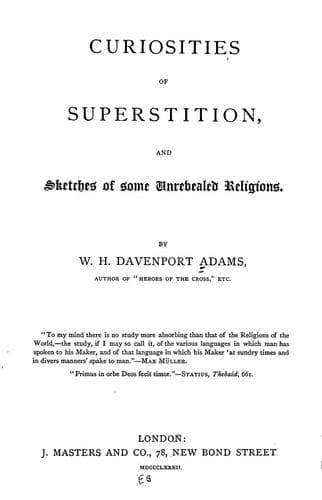
Curiosities of Superstition, and Sketches of Some Unrevealed ReligionsAdams, W. H. Davenport (William Henry Davenport)
Religion
Curiosities of Superstition, and Sketches of Some Unrevealed Religions
Adams, W. H. Davenport (William Henry Davenport)
Folklore; Religions; Superstition
Zoroaster, 45.
Zulu Witch-finders, 180.
J. MASTERS AND CO., PRINTERS, ALBION BUILDINGS, BARTHOLOMEW CLOSE.
FOOTNOTES:
[1] Miss Gordon Cumming, “From the Hebrides to the Himalayas,” ii. 226,
227.
[2] Max Müller, Buddhism and Buddhist Pilgrims, pp. 5, 6.
[3] Rig-Veda, i. 164, 46.
[4] Rig-Veda, x. 121, by Max Müller.
[5] The thought in this paragraph, and several of the expressions, are
from Max Müller.
[6] So in Shelley’s lyrical drama of “Prometheus Unbound:”--
“_Mercury_ (addressing Prometheus.) Once more answer me:
Thou knowest not the period of Jove’s power?
_Prometheus._ I know but this, that it must come.
_Mercury._ Alas!
Thou canst not count thy years to come of pain.
_Prometheus._ They last while Jove must reign; nor more nor less
Or I desire or fear.”
[7] Max Müller, pp. 13, 14.
[8] Professor Wilson propounded a theory to the effect that there never
was any such man as Buddha, but the theory has found few supporters.
[9] The name “Sakya” is made into “Sakya-muni,”--_muni_ in Sanskrit
meaning “solitary,” (Greek, μόνος,) alluding to his solitary habits; and
to Gautama is often prefixed “Sramana,” or “ascetic.”
[10] Max Müller, pp. 14, 15.
[11] Max Müller, pp. 15, 16, 17.
[12] The following sketch is founded on M. Stanislas Julien’s “Voyages des
Pélerins Buddhistes,” and on Max Müller’s review of that valuable work.
[13] Max Müller, p. 36.
[14] Voyages des Pélerins Bouddhistes. Vol. I. Histoire de la Vie de
Hiouen-thsang, et ses Voyages dans l’Inde, depuis l’an 629 jusqu’en 645,
par Hoeï-li et Yen-thsong; traduite du Chinois par Stanislas Julien.
Vol. II. Mémoires sur les Contrées Occidentales, traduits du Sanscrit en
Chinois, en l’an 648, par Hiouen-thsang, et du Chinois en Français, par
Stanislas Julien. Paris, 1853-1857. B. Duprat.
[15] Hoeï-li terminates the last book of his biography of the Master with
a long and pompous panegyric of Hiouen-thsang. This _morceau_, which forms
(says Stanislas Julien,) twenty-five pages in the Imperial edition and ten
in the _Nan-king_, offers an analysis of the life and voyages of the
Master of the Law; but it contains no new fact or one of any interest in
relation to the history and geography of India or the Buddhist literature.
No English version has appeared of M. Julien’s elaborate translation of
the Chinese History of Hiouen-thsang.
[16] More correctly, Avesta-Zend.
[17] Sanscrit, _Avasthâ_. This is Haug’s conjecture.
[18] The Pazend language was identical with the Parsi, i.e., the ancient
Persian.
[19] Dogs are here associated with man on account of their high value in
an early stage of civilisation. Zarathustra protected them by special
ordinances and penalties.
[20] The bridge _Chinavat_ by which the souls of the good crossed into
Paradise; a fancy afterwards adopted by Muhámad.
[21] Quarles.
[22] Emanuel Deutsch, “Literary Remains,” (edit. 1874, pp. 32, 33.)
Public-domain text, read in full here on John Shaqi.
Reviews
Reviews
No reviews yet
Be the first to share your thoughts on this work.
Elsewhere in the archive
Join the Discussion
Join the discussion
Sign in to leave a comment or review.
Sign InorCreate an account