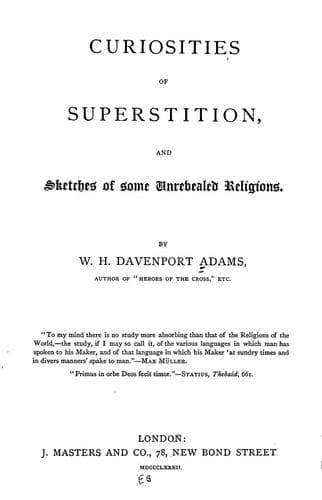
Curiosities of Superstition, and Sketches of Some Unrevealed ReligionsAdams, W. H. Davenport (William Henry Davenport)
Religion
Curiosities of Superstition, and Sketches of Some Unrevealed Religions
Adams, W. H. Davenport (William Henry Davenport)
Folklore; Religions; Superstition
[52] “We know,” says Mr. Fergusson, “that two of the principal Vedic
gods--Indra (the firmament) and Agni (fire)--were adopted into their
pantheon by the early Buddhists, and it seems more reasonable to connect
this appearance of fire with the pre-existing worship of Agni than with
any far-fetched allusion to solar worship.” But what was Agni but a type
of the sun?
[53] Col. Meadows Taylor, Appendix to Fergusson’s “Tree and
Serpent-worship,” pp. 236, 237.
[54] John Williams, “Missionary Enterprises,” p. 48.
[55] Rev. J. Williams, “Missionary Enterprises,” pp. 143-146 (edit. 1841.)
[56] “South Sea Bubbles,” by the Earl and the Doctor, pp. 114-117.
[57] R. F. Burton, “Lake Regions of Equatorial Africa.”
[58] Tennyson.
[59] Cooper, pp. 102, 104.
[60] Cooper, p. 105.
[61] Dishes.
[62] Empty.
[63] Puffed.
[64] Ash, or cinder.
[65] Saucy child.
[66] The unbounded good fortune of Polycrates, King of Samos, awakened the
fear of his friend, Amasis, King of Egypt, who wrote to warn him of the
jealousy of the gods:--
“This counsel of thy friend disdain not--
Invoke Adversity!
And what of all thy worldly gear,
Thy deepest heart esteems most dear,
Cast into yonder sea!”
[67] Calcutta Review, LI. iii.
[68] Calcutta Review, LI., 118. In the Gaelic we find a similar story,
called “Moorochug and Meenachug.”
[69] We have Anglicised Mr. Dalyell’s version. See his “Darker
Superstitions of Scotland,” p. 22. (Edit. 1835.)
[70] This is the subject of D. G. Rossetti’s fine poem, “The King’s
Tragedy.”
[71] At the beginning of the action he had taken his place in front of his
little band of cavalry. He bade them follow him, and rode forward. But it
seemed to be decreed that, on that day, the lowland Scotch should in both
armies appear to disadvantage. The horse hesitated. Dundee turned round,
stood up in his stirrups, and, waving his hat, invited them to come on. As
he lifted his arm, his cuirass rose, and exposed the lower part of his
left side. A musket ball struck him: his horse sprang forward, and plunged
into a cloud of smoke and dust, which hid from both armies the fall of the
victorious general. A person named Johnstone was near him, and caught him
as he sank down from the saddle. “How goes the day?” said Dundee. “Well
for King James,” answered Johnstone; “but I am sorry for your lordship.”
“If it is well for him,” answered the dying man, “it matters the less for
me.” He never spoke again: but when, half an hour later, Lord Dunfermline
and some other friends came to the spot, they thought that they could
still discover some faint remains of life. The body, wrapped up in two
plaids, was carried to the Castle of Blair.--_Macaulay_, chap. xiii.
[72] Æneid. lib. vii. l. 87.
[73] Milton.
Public-domain text, read in full here on John Shaqi.
Reviews
Reviews
No reviews yet
Be the first to share your thoughts on this work.
Elsewhere in the archive
Join the Discussion
Join the discussion
Sign in to leave a comment or review.
Sign InorCreate an account