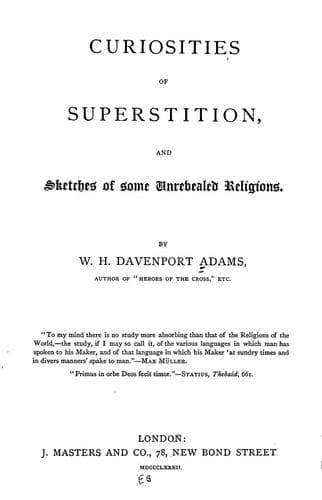
Curiosities of Superstition, and Sketches of Some Unrevealed ReligionsAdams, W. H. Davenport (William Henry Davenport)
Religion
Curiosities of Superstition, and Sketches of Some Unrevealed Religions
Adams, W. H. Davenport (William Henry Davenport)
Folklore; Religions; Superstition
We may point to a remarkable contrast between Magianism and
Christianity,--that the former has undergone an almost complete revolution
of meaning and doctrine, while, in spite of sectarian glosses, the latter
remains virtually unaltered. The faith once for all delivered to the
saints is held by believers to-day in all its original purity. We repeat
the Creed just as it fell from the rapt lips of martyrs, saints and
confessors. But the monotheism of Zarathustra has been broken up into a
curious Dualism; and upon the religious system of the Gâthas has been
accumulated such a burden of ritual, of novel teaching, of borrowed
dogmas, and alien mysteries, that the acutest students are almost baffled
in their endeavours to distinguish the false from the true, and the new
from the old. It is almost impossible to determine what belongs to the
Zarathustrian original, and what to perversions or adaptations from the
Jewish Scriptures.
It is an indisputable testimony to the living force and divine genius of
Christianity, that it occupies a void which no one of the primitive
religions has ever been able to fill. We find it difficult to conceive
that any man who has once been a Christian could voluntarily embrace
Zarathustrianism or Buddhism, and attempt to satisfy his soul with it, any
more than with the philosophy of the Stoics. We are tempted to ask,
indeed, whether either could at any time have satisfied the cravings of
humanity. We know that all their ethical schemes could not lift the sages
of Greece and Rome out of the deep, the intense sadness which possessed
them, nor respond to their yearnings after a something they could neither
describe nor define. Their state of thought and feeling has been expressed
by a modern poet, Matthew Arnold, with what seems to us a wonderful
fidelity:--
“Nor only in the intent
To attach blame elsewhere,
Do we at will invent
Stern powers who make their care
To embitter human life, malignant deities.
“But next, we would reverse
The scheme ourselves have spun,
And what we made to curse
We now would lean upon,
And feign kind gods who perfect what man vainly tries....
“We pause, we hush our heart,
And then address the gods:
‘The world hath failed to impart
The joy our youth forebodes,
Failed to fill up the void which in our breasts we bear!’”
Public-domain text, read in full here on John Shaqi.
Reviews
Reviews
No reviews yet
Be the first to share your thoughts on this work.
Elsewhere in the archive
Join the Discussion
Join the discussion
Sign in to leave a comment or review.
Sign InorCreate an account