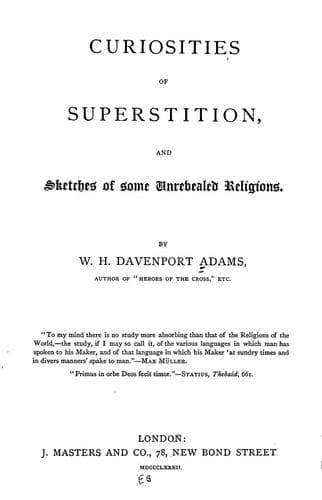
Curiosities of Superstition, and Sketches of Some Unrevealed ReligionsAdams, W. H. Davenport (William Henry Davenport)
Religion
Curiosities of Superstition, and Sketches of Some Unrevealed Religions
Adams, W. H. Davenport (William Henry Davenport)
Folklore; Religions; Superstition
The exact relation of Zarathustrianism to Christianity it is somewhat
difficult to define, because a cloud of doubt and uncertainty hangs over
the compilation of the later portions of the Zendavesta. While the great
antiquity of the Gâthas cannot be disputed, while there is clear evidence
that they contain much of the original teaching of Zarathustra,--teaching
nobler and more exalted than that of his followers,--it seems not less
certain that the doctrines of the Resurrection and the Future Life were
borrowed from the Hebrews. What then is left to justify a comparison with
Christianity? The keynote of its scheme is intellectual pride; that of the
Christian religion, spiritual abasement. The former urges on its disciples
the necessity of good thoughts, words, and deeds in order to please
Ahura-Mazda; the latter, as a proof of faith in the mission of its
Founder. The former teaches an excellent code of morals, so far as relates
to the individual; the latter lays down one golden rule, “Do unto others
as thou wouldest they should do unto thee.” The former enforces the law of
self-control; the latter of self-renunciation. It is impossible to pretend
that Magianism shows the same insight into man’s wants, failings,
passions, temptations, as Christianity shows; or provides a system so
capable of adaptation to every age, and rank, and character.
We see no reason to doubt the authenticity and antiquity of the
Zendavesta; but it is somewhat surprising that scholars who make haste to
accept _it_ as genuine, should show so much scepticism in reference to the
Christian Scriptures. Surely, as regards the latter, the evidence of
genuineness is infinitely stronger than as regards the former. We know
that they were implicitly accepted by men who lived almost in the very
time of those who recorded them; on the other hand, of Zarathustra and his
contemporaries or successors we know absolutely nothing. Some authorities
represent him to have flourished as early as 2200 B.C.; others as late as
500 B.C. Some consider him to have been the founder of a dynasty; others
invest him with a supernatural personality. But at the best he remains
_nominis umbra_; as indistinct and shadowy, as in his teaching he is cold
and clear. Of the authenticity of his writings the principal proofs are
those derivable from the writings themselves. But if we allow that such
proofs are admissible, what shall we say of those to be found in the
Gospels and Epistles? As their morality is so much more elevated than that
of the Zendavesta, so is the certainty of their Divine origin infinitely
more assured. The class of testimony which asserts the authenticity of the
one not less convincingly affirms the genuineness of the other. And if the
Gospels are all that they purport to be, how can we avoid the conclusion
that they are truthful also in the witness they bear to the life and
character of CHRIST?
Public-domain text, read in full here on John Shaqi.
Reviews
Reviews
No reviews yet
Be the first to share your thoughts on this work.
Elsewhere in the archive
Join the Discussion
Join the discussion
Sign in to leave a comment or review.
Sign InorCreate an account