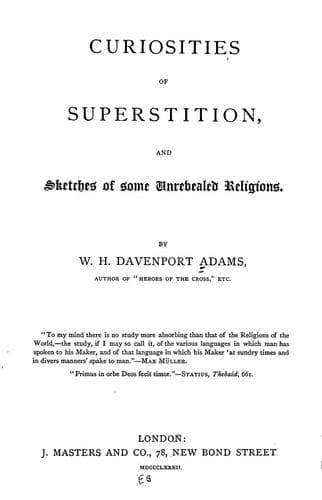
Curiosities of Superstition, and Sketches of Some Unrevealed ReligionsAdams, W. H. Davenport (William Henry Davenport)
Religion
Curiosities of Superstition, and Sketches of Some Unrevealed Religions
Adams, W. H. Davenport (William Henry Davenport)
Folklore; Religions; Superstition
GOD forbid that we should deny a certain value even to the “unconscious
prophecies of heathendom,” or refuse to see something of the spirit of
CHRIST in the teaching of the ancient sages and philosophers; but when an
attempt is made to raise Magianism to an equal rank with Christianity, and
the cold intellectual utterances of the Zendavesta to rank with the
living voices of Holy Writ, it is essential to point out how vast, how
impassable is the gulf between them; how little Magianism did or could do
to elevate man’s spiritual nature; and how largely Christianity surpasses
it, in and through the manifestation of the Divine love in the mystery of
GOD made Man.
CHAPTER III.
_JEWISH SUPERSTITIONS._
THE TALMUD.
The Talmud, (from the Hebrew _lamad_, to learn,) is the name given to the
great code of the Jewish civil and canonical law. It is divided, like the
Zendavesta, into two parts, the Mishna and the Gemara; the former being,
as it were, the text, and the latter the commentary and supplement. Of
late years public attention has been exceptionally drawn to it by the
writings of the late Emanuel Deutsch, and it has obtained, as we think, a
wholly undeserved amount of panegyric.
Deutsch, an enthusiast in his attachment to the land and religion of his
forefathers, put it forward as a wondrous treasure, the real value of
which had been wholly overlooked. It contained, he seemed to say, a
complete _corpus juris_; and, as an encyclopædia of law, should be
compared with the corresponding collections of Roman or of English law,
with the Pandects of Justinian and the Commentaries of Blackstone. Herein
lies the excuse for rules that have been considered unduly subtle, or in
other ways offensive to modern taste. But it contains something more than
a body of law; it is also a collection of Jewish poetry and legend, of
Jewish science, and Jewish metaphysical speculation. The Mishna is a
development of the laws contained in the Pentateuch. The members of the
Sanhedrim, who were chiefly concerned in the formation of this law, were
obliged (so argues Deutsch) to be accomplished men. It was necessary that
they should possess some knowledge of physical science, or at least of
zoology, botany, and geography in their then condition. It was necessary
also that they should be good linguists, having some acquaintance with
Latin and Greek, as well as with Aramaic, Syriac, and Hebrew. Disreputable
men were kept out, and all were compelled to be married men and fathers of
families. “The origin of the Talmud,” he says, “is coeval with the return
from the Babylonish captivity.” And though it is the glory of Christianity
to have carried into the heart of humanity at large the golden germs of
thought previously hidden in the schools of the learned, yet numerous
precepts, supposed to be purely Christian, lie enshrined in the pages of
the Talmud. It would be difficult to find a penal legislation more
distinctly humane. As for its myths, its allegories, its apparent
Public-domain text, read in full here on John Shaqi.
Reviews
Reviews
No reviews yet
Be the first to share your thoughts on this work.
Elsewhere in the archive
Join the Discussion
Join the discussion
Sign in to leave a comment or review.
Sign InorCreate an account