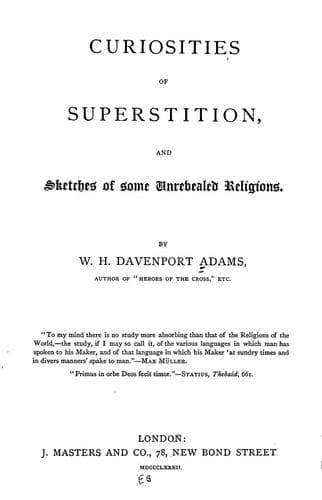
Curiosities of Superstition, and Sketches of Some Unrevealed ReligionsAdams, W. H. Davenport (William Henry Davenport)
Religion
Curiosities of Superstition, and Sketches of Some Unrevealed Religions
Adams, W. H. Davenport (William Henry Davenport)
Folklore; Religions; Superstition
absurdities, they should be read in the spirit in which Christians read
Bunyan’s “Pilgrim’s Progress.” The Talmud insists upon the pre-existence
of the soul, on the dogmas of Immortality and the Resurrection, it denies
the doctrine of everlasting damnation; it excludes no human being from the
world to come. And as the Talmud, continues Deutsch, although redacted at
a later period, is, in point of time, prior to the New Testament, the
beautiful maxims of the former cannot have been borrowed from the latter.
In a word, it is a collection which took nearly a thousand years to form,
and has been commented upon for a thousand years since. It breathes
charity to all men. If we except a few items of coarseness, such as must
occur in every legal code, it is all good; at least, it is never bad; it
deserves all possible respect and even reverence. Such, in a condensed
form, is the account of the Talmud which Deutsch asks us to accept.
But it cannot be admitted that the defects of the Talmud are trivial, any
more than that the spirit of the Rabbins towards Christianity was
tolerant. Nor can it be admitted that the Talmud owes nothing to the
Christian Scriptures.
On the first point hear what Professor Hurwitz says:--“The Talmud contains
many things which every enlightened, nay, every pious Jew, must sincerely
wish had never appeared there, or should at least long ago have been
expunged from its pages. Some of these Agadatha are objectionable _per
se_; others, indeed, are susceptible of explanations, but without them are
calculated to produce false and erroneous impressions.” So much may be
said, we think, of the legends in the Talmud; such as the size of
Leviathan and the way in which he is to be killed and cooked for the
chosen people, and the marriage of Adam with Lilith before the creation of
Eve, with the diabolic progeny which sprang from them.
Another point to be considered is the influence of the Alexandrian books,
commonly known by us as the Apocrypha. Of these the Books of Wisdom and
Ecclesiasticus at any rate exhibit the reflections of singularly devout
and thoughtful minds, which had exercised themselves in the contemplation
of the writings of Moses and the prophets in combination with no
inconsiderable tincture of Greek philosophy. It would be a question of
great interest to see how far ideas suggested in those very remarkable
compositions have found their way into the Talmud.
Public-domain text, read in full here on John Shaqi.
Reviews
Reviews
No reviews yet
Be the first to share your thoughts on this work.
Elsewhere in the archive
Join the Discussion
Join the discussion
Sign in to leave a comment or review.
Sign InorCreate an account