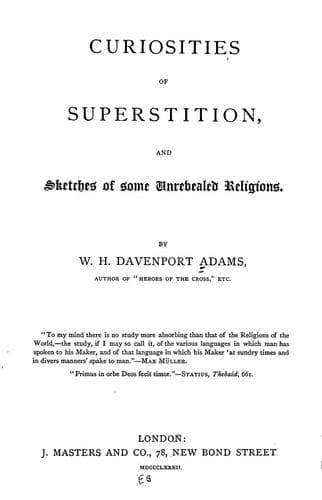
Curiosities of Superstition, and Sketches of Some Unrevealed ReligionsAdams, W. H. Davenport (William Henry Davenport)
Religion
Curiosities of Superstition, and Sketches of Some Unrevealed Religions
Adams, W. H. Davenport (William Henry Davenport)
Folklore; Religions; Superstition
But for our part we wholly dissent from this extraordinary theory, which,
indeed, cannot be supported by any chronological evidence. There are
occasions, of course, in which dates become of comparatively trifling
importance. A man feels troubled, for example, with the enigmas of life,
and finds light and consolation in reading the book of Job; that most
beautiful book--_quel bellissimo libro_, as the Italian poet Giusti called
it. Some friend, finding him thus engaged, begins to argue in favour of
Bishop Warburton’s view, that it is a composition of comparatively late
date, perhaps of the age of Jeremiah, and not (as used to be generally
supposed) as early as the time of Moses. In such a case a man may well
reply, that without any wish to discourage critical inquiry in its proper
place, he is content for the present to go on reading for his soul’s
health, to accept the words before him as a message from above, and to
feel sure that whenever GOD gave it, it was given at the time when it was
most needed. But in the case of the Talmud dates are of real and living
importance, though we own that it is difficult to fix them with accuracy.
We believe, however, with one of Deutsch’s critics, that Christian
elements _have_ found their way into the Talmud, though doubtless,
pre-Christian ideas, similar to those which are met with in the Books of
Wisdom and Ecclesiasticus, are also to be found there. Is it not true that
the Mishna was brought into its present form by Rabbi Jehudah, surnamed
the Holy, about A.D. 200, and that the Gemara was not completed until A.D.
500? Deutsch, indeed, appeals to the article in the “Novellæ
Constitutiones” (or _Novels_, as they are commonly called) of Justinian
against the Talmud. The reference is correct enough, but the _Novels_
belong to the later parts of Justinian’s reign, and were not promulgated
before the year 534.
It is well known that at the present time there are three parties among
the Jews who differ widely as to the amount of respect which ought to be
paid to the legislation contained within the pages of the Talmud. Two out
of these parties would greatly modify it, or actually sweep it away. We
believe that its influence upon practice is not destined to endure; and
that though there _is_ a book which will continue so to influence life,
that book is not the Talmud, but the Bible. The Talmud has its curiosities
and even beauties, as well as its gross absurdities and defects; but,
after all, it will be found, we believe, that it often reflects but too
truly the mind of those of whom it was said, “Ye have made the commandment
of GOD of none effect by your traditions.”
* * * * *
With these preliminary observations, we pass on to a more particular
description of the Talmud.
Public-domain text, read in full here on John Shaqi.
Reviews
Reviews
No reviews yet
Be the first to share your thoughts on this work.
Elsewhere in the archive
Join the Discussion
Join the discussion
Sign in to leave a comment or review.
Sign InorCreate an account