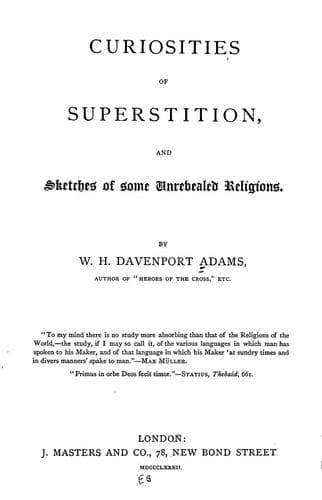
Curiosities of Superstition, and Sketches of Some Unrevealed ReligionsAdams, W. H. Davenport (William Henry Davenport)
Religion
Curiosities of Superstition, and Sketches of Some Unrevealed Religions
Adams, W. H. Davenport (William Henry Davenport)
Folklore; Religions; Superstition
There are two Talmuds, the one called the Talmud of the Occidentals, or
the “Jerusalem” Talmud, and the other the “Babylonian” Talmud. The former
of these originally included the whole of the first five _Sedarim_ (or
portions,) but now consists of only thirty-nine treatises. Its final
redaction is supposed to have taken place towards the close of the fourth
Christian century, but the authorities engaged in the work cannot now be
determined. But it is certainly distinguished by more accuracy of
expression and precision of statement than the second or Babylonian, or
“our” Talmud, which makes use of its predecessor, and was not completed
for a century later. Its editor is generally considered to be Rabbi Ashi,
president of the Academy of Syro in Babylon (A.D. 365-427.) Both the
Mishna, though revised in A.D. 219, and the “Palestine” Gemara, had become
greatly corrupted through the interpolation of gross traditions and the
critical judgments of different schools, when Rabbi Ashi, with the
assistance of his friend and disciple, Abina, undertook the labour of
sifting the old from the new, and introducing order into chaos.
Ashi was appointed to the headship of the school of Sora at the age of
twenty-three, and under his rule Sora became the head-quarters of
Rabbinism in the East. When he entered on the redaction of the Mishna and
Gemara, he began by assembling yearly at the great feasts the most learned
Hebrews, and examining them with respect to their traditional practices
and expositions. He then called together his disciples every spring, and
gave out to them a particular treatise of the Mishna; in the autumn they
again came before him with all the information relative to it they had
collected in the interval. This he personally investigated, and reduced
into shape. The Mishna being composed of sixty-three treatises, he was
thus engaged for upwards of thirty years. The final revision occupied him
twenty-two years. At the time of his death (in his seventy-fifth year) the
work was all but completed; the last touches were given by his friend,
Rabbi Abina.
The Mosaic is the written law of the Jews; the Mishna, the oral. The
latter is the very basis of Judaism, is its civil, religious, and
juridico-political code,--an explanation and amplification of the Mosaic.
It was developed out of the authoritative decisions of the schools and of
certain distinct and well-authenticated traditions which were traced back
to Sinai itself. Thus there were two chief sections, or parts: _Halacoth_,
the rabbinical decisions, and _Haggadah_, the traditional narratives and
popular illustrations. Of the great bulk of the former the reputed author
is Hillel, the head of the Sanhedrim in the early part of Herod the
Great’s reign, but, probably, he only collected them. Maimonides arranges
them under five heads:--
_a._ Mosaic and Scriptural;
_b._ Mosaic and traditional;
_c._ Dicta and decisions generally received, but doubtful;
Public-domain text, read in full here on John Shaqi.
Reviews
Reviews
No reviews yet
Be the first to share your thoughts on this work.
Elsewhere in the archive
Join the Discussion
Join the discussion
Sign in to leave a comment or review.
Sign InorCreate an account