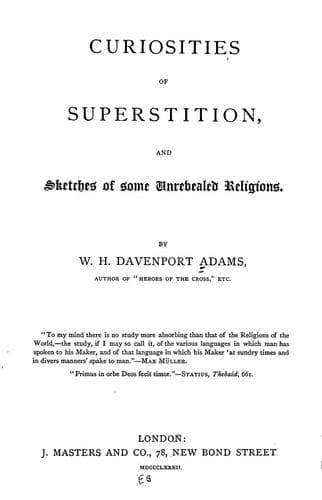
Curiosities of Superstition, and Sketches of Some Unrevealed ReligionsAdams, W. H. Davenport (William Henry Davenport)
Religion
Curiosities of Superstition, and Sketches of Some Unrevealed Religions
Adams, W. H. Davenport (William Henry Davenport)
Folklore; Religions; Superstition
Commenting on this statement, Colonel Yule observes that the modern
snake-charmers do not seem entitled to the distinctive appellation of
Abraiaman, or Brahmans, though they may have been so in former days. At
the diamond-mines of the Northern Circars Brahmans are employed in the
similar task of propitiating the tutelary genii. The snake-charmers are
called in Tamul _Kadal-kalti_, “Sea-binders,” and in Hindustani,
_Haibanda_, or “Shark-binders.” At Aripo they belong to one family,
supposed to enjoy monopoly of the charm. The chief operator is (or was,
not many years ago) paid by Government, and he also received two oysters
from each boat daily during the fishery. Turnoub, on his visit, found the
incumbent of the office to be a Roman Catholic Christian, but that did not
seem to affect the exercise or the validity of his practices. It is
remarkable that when Turnoub wrote, not more than one authenticated
accident from sharks had taken place, during the whole period of the
British occupation.
* * * * *
Among the shepherds, or hillmen, in the neighbourhood of Rampore (or “City
of Rama,”)--the Paharis, as they are called,--a curious custom lingers,
which resembles the strange old Highland ceremony of the sunwise turn, or
Deisul, round any particular object, partly for luck, partly as a survival
of the sun-worship of the men of old. Sometimes the villagers gather their
flocks into one great herd, and, walking at the head, lead them slowly
round the village, following the solar course. Gradually they quicken
their pace to a run, and in this fashion perambulate the village thrice or
even oftener.
This sunwise turn is practised in other cases, as in sickness or accident.
Sheep and goats are solemnly paraded round the sufferer; after which they
lose their heads. If the sufferer be wealthy, the number so sacrificed to
the demons is often considerable. But the Paharis very firmly hold that
though the lesser spirits may be thus propitiated, no sacrifice is
acceptable to the Supreme Deity; that all He claims is devout worship.
Public-domain text, read in full here on John Shaqi.
Reviews
Reviews
No reviews yet
Be the first to share your thoughts on this work.
Elsewhere in the archive
Join the Discussion
Join the discussion
Sign in to leave a comment or review.
Sign InorCreate an account