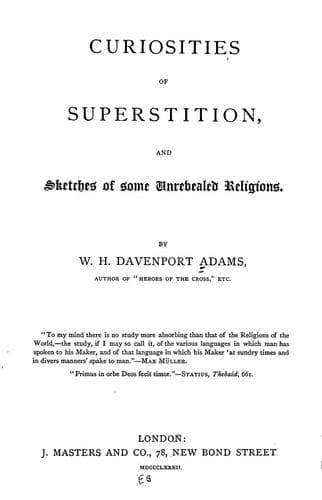
Curiosities of Superstition, and Sketches of Some Unrevealed ReligionsAdams, W. H. Davenport (William Henry Davenport)
Religion
Curiosities of Superstition, and Sketches of Some Unrevealed Religions
Adams, W. H. Davenport (William Henry Davenport)
Folklore; Religions; Superstition
Daksha, the patriarch, his sacrifice being destroyed, overcome with
terror, and utterly broken in spirit, fell prone upon the ground, where
his head was spurned by the feet of the cruel Virabhadra. The thirty
scores of sacred divinities were all presently bound, with a band of fire,
by their lion-like foe; and they all addressed him, crying: “O Rudra, have
mercy upon thy servants! O lord, dismiss thine anger!” This spake Brahma,
and the other gods, and the patriarch Daksha; and, raising their hands,
they said: “Declare, mighty being, who thou art.”
Virabhadra said: “I am not a god, nor an Aditya, nor am I come hither for
enjoyment, nor curious to behold the chiefs of the divinities. Know that I
am come to destroy the sacrifice of Daksha, and that I am called
Virabhadra, the issue of the wrath of Rudra. Bhadrakali, also, who has
sprung from the anger of Devi, is sent here, by the god of gods, to
destroy this rite. Take refuge, king of kings, with him who is the lord of
Uma. For better is the anger of Rudra than the blessings of other gods.”
Having heard the words of Virabhadra, the righteous Daksha propitiated the
mighty god, the holder of the trident, Maheswara. The hearth of sacrifice,
deserted by the Brahmans, had been consumed; Yajna had been metamorphosed
to an antelope; the fires of Rudra’s wrath had been kindled; the
attendants, wounded by the tridents of the servants of the god, were
groaning with pain; the pieces of the uprooted sacrificial posts were
scattered here and there; and the fragments of the meat-offerings were
carried off by flights of hungry vultures and herds of howling jackals.
Suppressing his vital airs, and taking up a posture of meditation, the
many-sighted victor of his foes, Daksha, fixed his eyes everywhere upon
his thoughts. And the god of gods appeared from the altar resplendent as a
thousand suns, and smiling upon him, said, “Daksha, thy sacrifice has been
destroyed through sacred knowledge, I am well pleased with thee.” And he
smiled again, and exclaimed, “What shall I do for thee? Declare, together
with the preceptor of the gods.”
And Daksha, frightened, alarmed, and agitated, his eyes suffused with
tears, raised his hands reverently to his brow, and said, “If, lord, thou
art pleased; if I have found favour in thy sight; if I am to be the object
of thy benevolence; if thou wilt confer upon me a boon, this is the
blessing I solicit, that all these provisions for the solemn sacrifice
which have been collected with much trouble and during a long time, and
have now been eaten, drunk, devoured, burnt, broken, scattered abroad, may
not have been prepared in vain.” “So let it be,” replied Hara, the subduer
of Indra. And thereupon Daksha knelt down upon the earth, and praised
gratefully the author of righteousness, the three-eyed god Mahádeva,
repeating the eight thousand names of the deity whose emblem is a bull.
_Public Games._ (Bk. v., c. 10.)
Public-domain text, read in full here on John Shaqi.
Reviews
Reviews
No reviews yet
Be the first to share your thoughts on this work.
Elsewhere in the archive
Join the Discussion
Join the discussion
Sign in to leave a comment or review.
Sign InorCreate an account