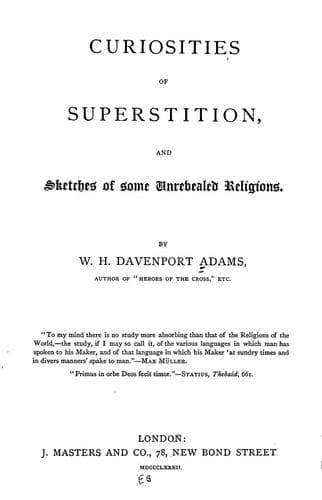
Curiosities of Superstition, and Sketches of Some Unrevealed ReligionsAdams, W. H. Davenport (William Henry Davenport)
Religion
Curiosities of Superstition, and Sketches of Some Unrevealed Religions
Adams, W. H. Davenport (William Henry Davenport)
Folklore; Religions; Superstition
“How shall the tongue of a mortal such as I am call the creator of all
things, who is without beginning or end, son? Is it consistent that the
lord of the world, from whom the world proceeds, should be born of me,
except through illusion? How should he, in whom all fixed and moveable
things are contained, be conceived in the womb and born of a mortal being?
Have compassion, therefore, indeed, O supreme lord, and, in thy descended
portions, protect the universe. Thou art no son of mine. This whole world,
from Brahma to a tree, thou art. Wherefore dost thou, who art one with the
Supreme, beguile us? Blinded by delusion, I thought thee my son, and for
thee, who art beyond all fear, I dreaded the anger of Kamsa; and,
therefore, did I take thee, in my turn, to Gokula, where thou hast grown
up. But I no longer claim thee as mine own. Thou, Vishnu,--the sovereign
lord of all, whose actions Rudra, Maruts, the Aswins, Indra, and the gods
cannot equal, although they behold them; thou, who hast come amongst us,
for the benefit of the world,--art recognised; and delusion is no more.”
We shall furnish but one other specimen:--
_Anecdotes of Khandikya and Kesidhwaja._
Maitreya, addressing Parasara, says: “Reverend teacher, I am desirous of
being informed what is meant by the term meditation (_yoga_), by
understanding which I may behold the Supreme Being, the upholder of the
universe.”
Parasara, in reply, says that he will repeat the explanation formerly
given by Kesidhwaja to the magnanimous Khandikya, also called Janaka.
Whereupon Maitreya replies: “Tell me, first, Brahman, who Kandikya was and
who Kesidhwaja; and how it happened that a conversation relating to the
practice of Yoga occurred between them.”
Thereupon follows Parasara’s narrative:
There was Janaka, named Dharmadhwaja, who had two sons, Mitadhwaja and
Kritadhwaja; and the latter was a king ever intent upon existent supreme
spirit: his son was the celebrated Kesidhwaja. The son of Mitadhwaja was
Janaka, called Khandikya. Khandikya was diligent in the way of works, and
was renowned, on earth, for religious rites. Kesidhwaja, on the other
hand, was endowed with spiritual knowledge. These two were engaged in
hostilities; and Khandikya was driven from his principality by Kesidhwaja.
Expelled from his dominions, he wandered, with a few followers, his
priest, and his counsellors, amidst woods and mountains, where, destitute
of true wisdom, he performed many sacrifices, expecting, thereby, to
obtain divine truth, and to escape from death by ignorance.
Public-domain text, read in full here on John Shaqi.
Reviews
Reviews
No reviews yet
Be the first to share your thoughts on this work.
Elsewhere in the archive
Join the Discussion
Join the discussion
Sign in to leave a comment or review.
Sign InorCreate an account