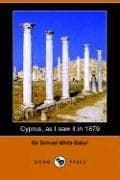
Cyprus, as I Saw It in 1879Baker, Samuel White, Sir
History
Cyprus, as I Saw It in 1879
Baker, Samuel White, Sir
Cyprus -- Description and travel
The water-gate was approached by a winding entrance beneath a powerful
circular bastion from an extremely narrow quay, from which the remains
of a once powerful mote projected about 120 yards into the sea and
commanded the inner harbour. This was now a mere line of loose and
disjointed stones. A citadel that is separated from the main fortress by
a wet ditch which communicates with the sea by an adit beneath the wall
commands the harbour on the east side. This ditch is as usual scarped
from the rock, and otherwise of solid masonry; should the fortress have
been successfully carried by assault on the land side, a vigorous
defence might have been maintained in this independent citadel until
either reinforcements should arrive by sea, or an escape might be
effected to friendly vessels.
It is commonly asserted that Famagousta under the Lusignans and
Venetians "counted its churches by hundreds and its palatial mansions by
thousands." It would certainly have been impossible that they could have
existed within the present area, as a large extent must have been
required for barrack accommodation for the garrison, parade-grounds, &c.
There are ruins of several fine churches with the frescoes still visible
upon the walls. The Cathedral of St. Nicholas is a beautiful object in
the Gothic style. Although dismantled and converted into a mosque by the
Turks, the roof is in good repair, and its magnificent proportions
remain, but they are marred by the stopping of the windows with rough
stones and mortar. The total length of the cathedral is 172 feet 6.5
inches. Length of apse (included in above) 30 feet 9 inches; breadth of
apse 32 feet 3 inches; breadth of cathedral 74 feet 1 inch;
circumference of pillars 15 feet 3 inches, there being 12 pillars in
all.
On the outside walls are the marks of various cannon-shot which appear
to have been successfully resisted by the soft but tough sedimentary
limestone, which is of similar quality to that used in the construction
of the fortress. I observed that the impact of the shot has been
confined to the immediate neighbourhood of the blow, and that the
concussion has not been communicated to the adjoining stone, but has
expended itself in crumbling the opposing surface to the depth in which
it was eventually imbedded. It would be interesting to try some
experiments upon those walls of Famagousta (which may already require
repair or alteration) with modern heavy artillery, as should this stone
exhibit unusual powers of resistance it may become valuable. Nothing
would be easier than to fire a few rounds from a ship's battery to prove
the question.
The courtyard of an ancient Venetian palace now forms the British
parade-ground. This faces the cathedral entrance, and is ornamented by
piles of marble cannon-shot, which are upwards of ten inches in
diameter; these were the Venetian relics of the siege of 1571.
Public-domain text, read in full here on John Shaqi.
Reviews
Reviews
No reviews yet
Be the first to share your thoughts on this work.
Elsewhere in the archive
Join the Discussion
Join the discussion
Sign in to leave a comment or review.
Sign InorCreate an account