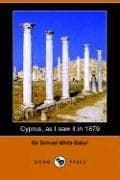
Cyprus, as I Saw It in 1879Baker, Samuel White, Sir
History
Cyprus, as I Saw It in 1879
Baker, Samuel White, Sir
Cyprus -- Description and travel
After a ride of two hours and a half we arrived at Caravastasi, and
halted in a very stony field at the back of the village, beneath an old
caroub-tree that had grown thick and shady by the merciless hacking of
its taller boughs, which had reduced it to a pollard. The village of
Caravastasi consists only of eight or ten houses, but is rendered
important by a Custom-house. It is situated on the most inland point of
Morphu Bay, and is slightly sheltered on the west by a promontory, which
forms a neat little cove for the protection of small vessels; but it is
completely open due north. Nothing would be easier than to construct a
small harbour, by extending a pier or breakwater from the end of the
promontory in the required direction; and the present unimportant
village would become only second in importance to Kyrenia.
The positions of ancient sea-port ruins attest the value that attached
to certain geographical points in former days, and although the vessels
of those periods may have been much inferior to ships of modern times,
they were sufficiently large for the commerce of the country and for the
capabilities of the harbours. The trade of Cyprus will always be carried
by vessels from twenty to one hundred and fifty tons, and there should
be no difficulty in providing shelter for ships of this small draught of
water. The ruins of Soli, on the west of the present village of
Caravastasi, prove that the Athenians, who founded the original city,
were thoroughly cognizant of the value of a position which is the only
spot upon the whole northern coast of Cyprus that will afford shelter or
a landing-place, excepting the harbour of Kyrenia. In the early period
of Cyprian history Soli represented one of the independent kingdoms when
the island was divided into ten, Amathus, Cerinea (Kyrenia), Citium,
Chytri, Curium, Lapithas, Marium, Nea-Paphos, Salamis, and Soli. The
Phoenicians, from their own southern position, naturally selected the
ports most convenient for their trade, and accordingly settled on the
south coast of Cyprus, their chief towns being Amathus, Citium, and
Paphos; these were important commercial ports at a time when Cyprus was
in its zenith of prosperity, and were sufficient for the requirements of
the period. If the British occupation is intended to be permanent it
will be highly necessary to determine the classes of harbours that
should be provided, as it would be a useless extravagance to expend
large sums upon the construction of ports beyond the necessities of the
trade. As I have already expressed an opinion that the commerce of
Cyprus will be represented by vessels of moderate tonnage, the necessary
protection for such vessels may be obtained at an equally moderate
outlay, and both Soli and Kyrenia may be made available as safe harbours
for all traders upon the northern coast. Famagousta would become the
arsenal and dockyard for ships of war; Larnaca and Limasol would be safe
Public-domain text, read in full here on John Shaqi.
Reviews
Reviews
No reviews yet
Be the first to share your thoughts on this work.
Elsewhere in the archive
Join the Discussion
Join the discussion
Sign in to leave a comment or review.
Sign InorCreate an account