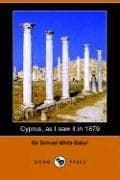
Cyprus, as I Saw It in 1879Baker, Samuel White, Sir
History
Cyprus, as I Saw It in 1879
Baker, Samuel White, Sir
Cyprus -- Description and travel
Where ancient forests have disappeared in favour of cultivation, it
would be folly to convert an improvement into the original wilderness.
That question is easily simplified, and when the department of Woods and
Forests shall be established, a few years of energy will produce a new
picture in a country where the growth of timber proceeds quickly.
But the last necessary reform still remains unnoticed; this should
determine the amount of caroubs, mulberry, and fruit-trees that should
be CUMPULSORILY planted by all proprietors of land in proportion to
their acreage; and this is absolutely necessary.
As I have described in many portions of our journey through Cyprus, the
simple action of an insignificant stream, or of a solitary cattle-wheel,
forms an oasis in the rainless desert of the Messaria, and the eye that
has been wearied with the barren aspect of a treeless surface is
gladdened by the relief of a sudden appearance of groves of oranges,
lemons, and other shady trees, the result of a supply of water. Whenever
such welcome spots are met with upon the miserable plain, the question
invariably arises, "Why should such fruitful and delightful positions be
so rare? The soil is fertile, the climate is favourable, all that is
required is water, and energy."
If a Cypriote is asked the question, he invariably replies "that during
the Turkish administration the fruit-trees increased their troubles,
owing to the vexatious and extortionate taxation of the crops, therefore
they were glad to be quit of them altogether." Your question No. 2
follows, "Why do you not plant trees now that the English have occupied
the country?" The reply is stereotyped, "We are not sure that you will
remain here permanently, and if you abandon the island the Turks will
resume the old system with even greater oppression than before." This is
an unanswerable dilemma, which no doubt retards improvements; but there
is a third difficulty which is invariably brought prominently forward
when any suggestions are made for an extension of agricultural
enterprise: "We have no money." This is absolutely true, although I have
heard the assertion contested by certain authorities. The people as a
rule are miserably poor, and cannot afford to run the risks of
experiments, especially during the present uncertainty connected with
the British occupation.
Public-domain text, read in full here on John Shaqi.
Reviews
Reviews
No reviews yet
Be the first to share your thoughts on this work.
Elsewhere in the archive
Join the Discussion
Join the discussion
Sign in to leave a comment or review.
Sign InorCreate an account