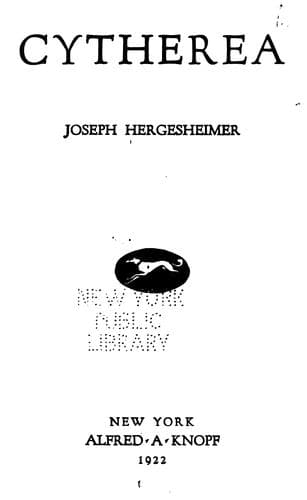
Adultery -- Fiction; Cuba -- Fiction; Runaway husbands -- Fiction
He put his glass down abruptly and tramped from wall to wall, his
unbuttoned silk waistcoat swinging about his arms. Lee Randon now cursed
himself, he cursed Savina, but most of all he cursed William Grove,
sleeping in complacent ignorance beside his wife. His imagination,
aroused and then defrauded, became violent, wilfully obscene, and
his profanity emerged from thought to rasping sound. His forehead, he
discovered, was wet, and he dropped once more into the chair by the
laden tray, took a deep drink from a fresh concoction. “This won't
do,” he said; “it's crazy.” And he resumed the comforting relief that
tomorrow would be different: he'd say good-bye to the Groves together
and, in four hours, he'd be back in Eastlake. The children, if he took
a late train, would be in bed, and Fanny, with her feet on the stool,
engaged with her fancy work.
Then his revolving thoughts took him back to the unanswered mystery
of what, actually, had happened to Savina and him. He lost her for
Cytherea, he lost Cytherea in her; the two, the immobile doll and the
woman torn with vitality, merged to confound him. In the consideration
of Savina and himself, he discovered that they, too, were alike;
yet, while he had looked for a beauty, a quality, without a name, a
substance, Savina wanted a reality every particle of which she had
experienced and achingly knew. He, more or less, was troubled by a
vision, but her necessity was recognizable in flesh. There, it might be
again, she was more fortunate, stronger, superior. It didn't matter.
No inclination to sleep drugged the activity of his mind or promised him
the release, the medicine, of a temporary oblivion. He had a recurrence
of the rebellious spirit, in which he wondered if Grove did sleep in
the same room with Savina. And then increasingly he got what he called
a hold on himself. All that troubled him seemed to lift, to melt into a
state where the hopeless was irradiated with tender memories. His
mood changed to a pervasive melancholy in which he recalled the lost
possibilities of his early ambitions, the ambitions that, without form
or encouragement, had gone down before definite developments. When he
spoke of these, tentatively, to Fanny, she always replied serenely that
she was thankful for him as he was, she would not have liked him to be
anything queer.
Public-domain text, read in full here on John Shaqi.
Reviews
Reviews
No reviews yet
Be the first to share your thoughts on this work.
Elsewhere in the archive
Join the Discussion
Join the discussion
Sign in to leave a comment or review.
Sign InorCreate an account