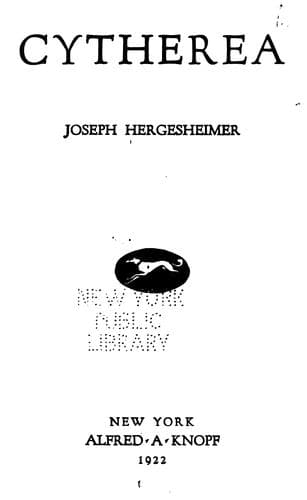
Adultery -- Fiction; Cuba -- Fiction; Runaway husbands -- Fiction
“I haven't the least interest in it,” Savina assured him; “I can't
imagine why we bought the seats. Why did we, Lee, when we have each
other?”
“Our own private Folly.” He smiled at her.
“Not that,” she reproved him; “I can't bear to think of it in a small
way. Why, it will be all I'll ever have--I shall never think of anyone
else like this again; and you'll go back, you'll go away. But I hope
you won't forget me, not at once--you must keep me in your heart for a
little.”
“I'll never be able to get you out,” he declared.
“You want to, then, and I am--” She lost control of herself as though
she had passed into a hypnosis, uniquely frozen with passion, incapable
of movement, of the accommodation of her sight; her breathing was slow,
almost imperceptible in its shallowness. “I am a part of you,” Savina
went on when she had recovered. “It would kill me if I weren't. But it
does mean something.” Her heel cut until he thought he was bleeding.
“What?” he asked, through the thin azure smoke of the cigar. She shook
her head contentedly:
“I don't care; I have--now, anyway--what I wish, what I've always wished
for--you. I didn't know it was you right away, how could I? Not even
when we had tea, and talked about Mina and your young Morris, that first
afternoon. It was the next day before I understood. Why wasn't it long
long ago, when I was a girl, twelve years old? Yes, quite that early.
Isn't it queer, Lee, how I have been troubled by love? It bothers hardly
anyone else, it scarcely touches the rest. There is a lot of talk
about it, but, all the while, people detest it. They are always wearing
dresses and pretentions they can't afford to have mussed. It--I am still
talking of love, Lee darling--breaks up their silly society and morals
... like a strong light thrown on something shabby.”
Once more he had the feeling that, before the actuality of Savina's
tragic necessity, his own speculations were merely visionary,
immaterial; yet he tried to put them into words, to explain, so far as
he was able, what it was in him that was hers. But he did this omitting,
perhaps, the foundation of all that he was trying to say--he didn't
speak of Cytherea. He avoided putting the doll into words because he
could think of none that would make his meaning, his attachment, clear.
Lee couldn't, very well, across the remnants of dinner, admit to Savina
that a doll bought out of a confectioner's window on Fifth Avenue so
deeply influenced him. He hadn't lost Cytherea in Savina so much as,
vitalized, he had found her. And, while he had surrendered completely
to the woman and emotion, at the same time the immaterial aspect of his
search, if he could so concretely define it, persisted. The difference
between Savina and himself was this: while she was immersed,
obliterated, satisfied, in her passion, a part of him, however small,
stayed aside. It didn't control him, but simply went along, like a
diminutive and wondering child he had by the hand.
Public-domain text, read in full here on John Shaqi.
Reviews
Reviews
No reviews yet
Be the first to share your thoughts on this work.
Elsewhere in the archive
Join the Discussion
Join the discussion
Sign in to leave a comment or review.
Sign InorCreate an account