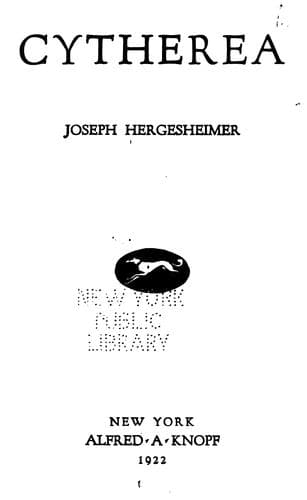
Adultery -- Fiction; Cuba -- Fiction; Runaway husbands -- Fiction
In his room he methodically and thoughtfully assembled the necessities
for his bag; he was arranging mentally the details of his act. Where,
primarily, it affected Fanny and the children, his lawyers could
handle it best; it was the present consequences to himself, the
step immediately before him, that demanded consideration. But his
deliberation was lost in the knowledge that he would go to New York
where, inevitably, he should see Savina. No one could predict what would
determine that; it would unfold, his affair with Savina must conclude,
as it had begun--in obedience to pressures beyond their control. An
increasing excitement flowed over him at the thought of being with her,
possessing her, again. There was no doubt of that in his mind; he knew
that Savina would come to him. She was far more ruthless in brushing
aside artificial barriers, prejudices, than, until now, he. The figure
of William Grove occupied him for a little, but he seemed insubstantial,
not so much a being as a convention to be smashed in his own house.
Lee Randon decided not to speak again, to say good-bye, to Fanny. It
would only multiply the difficulties of his leaving; she might have
another attack of rage, or--worse--of affection. He was amazed at his
lack of feeling, a little disturbed: perhaps there was something fatally
wrong, lacking, about him, and he was embarked on the first violent
stage of physical and mental degradation. It couldn't be helped, he told
himself, once more down stairs, in the hall. Beyond, the stool lay where
Fanny had kicked it; and he bent over to pick up the copper paper cutter
from the floor. Putting it on the table, he reflected that Fanny would,
in all probability, destroy it. His handkerchief, stiff, black with
dried blood, was in the crystal ash holder with a mahogany stand; and
that, as unnecessarily unpleasant, he hid in a pocket.
The electric globe in the floor lamp was yellow; it was nearly burned
out and would have to be replaced. This had been his special corner,
the most comfortable in the pen. But the pig, he remembered, had
been slaughtered last week; and he wondered if the parallel he
had established would hold true to the end. In the main aspect, he
concluded, yes. But the pig had died without experiencing what was,
undoubtedly, both the fundamental duty and recompense of living. The
pig, happily or unhappily, had remained in ignorance of Cytherea and the
delights of love; but, perhaps, if only for the moment, he had better
call that passion; it was a word of clearer, more exact, definition.
Public-domain text, read in full here on John Shaqi.
Reviews
Reviews
No reviews yet
Be the first to share your thoughts on this work.
Elsewhere in the archive
Join the Discussion
Join the discussion
Sign in to leave a comment or review.
Sign InorCreate an account