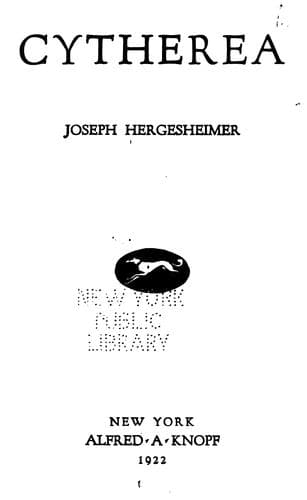
Adultery -- Fiction; Cuba -- Fiction; Runaway husbands -- Fiction
“It doesn't interest me.” Claire increasingly showed the strain, the
unhappiness, through which she was parsing. Nor did it him, he ended
lamely, except in the abstract. This at once had the elements of a lie
and the unelaborate truth; he couldn't see how his curiosity applied
to him, and yet he was intent on its solving. The fixed mobile smile of
Cytherea flashed into his thoughts. His perpetual restlessness struck
through him.
His attitude toward the Morrises was largely dictated by his fondness
for Claire. He had determined what, exactly, he would say to Peyton.
Yet, as a fact, he returned to his former assertion to Fanny; the boy
would make it difficult, if not impossible, to discuss such intimate
relationships. And as Claire had pointed out, the very openness
of Peyton's life would make him exceptionally far to reach; he was
particularly youthful in his hardness, his confidence in his acts and
friends and beliefs; yet all that couldn't help but be upset now.
“Fanny will think I have designs on you,” Claire remarked; “go up when
you like. I am not a bit sleepy.”
Lee had no intention of going to bed then, and told her so. It seemed to
him that, perhaps, with Claire, he might discover something that would
set his questioning at rest. Vain delusion. He asked what her plans
were:
“I'll stay in Eastlake for the winter, and, in March, go to Italy, to
give Peyton his divorce--Florence; I lived a while at Arcetri; it's very
lovely.”
He had a momentary experimental vision of a small yellow villa among
the olives of the Florentine hills, of crumbling pink walls with
emerald green lizards along the stones, of myrtles and remarkable
lilies-of-the-valley. Twenty years ago it would have drawn him
irresistibly; but not now; he wanted--where his wants were articulate--a
far different thing. It had nothing to do with Italy, or any other
country; his intentness had been withdrawn from the surfaces of life,
however charming; they had plunged into the profounder mysteries of
being. Lee had gained nothing if not a certain freedom from exterior
circumstance; his implied revolt against trivialities, if it did no
other good, had at least liberated him from the furniture of existence.
However, it had begun to appear that this was not an unmixed blessing;
he had the uncomfortable sensation of having put out, on a limitless
sea, in a very little boat too late to arrive at any far hidden
desirable coast.
Public-domain text, read in full here on John Shaqi.
Reviews
Reviews
No reviews yet
Be the first to share your thoughts on this work.
Join the Discussion
Join the discussion
Sign in to leave a comment or review.
Sign InorCreate an account