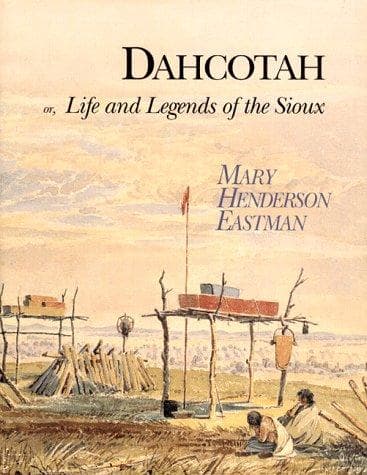
Dahcotah: Life and Legends of the Sioux Around Fort SnellingEastman, Mary H. (Mary Henderson)
History
Dahcotah: Life and Legends of the Sioux Around Fort Snelling
Eastman, Mary H. (Mary Henderson)
Dakota Indians -- Folklore; Dakota Indians -- History; Dakota Indians -- Social life and customs
The merciless Chippeways continued the work of death. The women and
children fled to their canoes, but the Chippeways were too quick for
them; and they only entered their canoes to meet as certain a fate as
those who remained.
The women had not their paddles with them, and there was an eddy in the
current; as soon as the canoe was pushed from the shore, it would whirl
round, and the delighted Chippeways caught the canoes, and pulled them
ashore again, while others let fall upon their victims the
uplifted tomahawk.
When the Chippeways had killed until they were tired they took what they
wanted from the Sioux camp, and started for home, taking one Dahcotah
boy prisoner. The party had not travelled far, when a number of
Dahcotahs attacked the Chippeways, but the latter succeeded in killing
many of the Dahcotahs. One of the latter fled, and was in his canoe on
the lake St. Croix, when the Chippeways suddenly came upon him.
The little Dahcotah saw his only chance for liberty--he plunged in the
water and made for the canoe of the Dahcotah. In a moment he had reached
and entered it, and the two Dahcotahs were out of sight before the
arrows of their enemies could reach them.
A very few of that band escaped; one of them says that when they were
first attacked by the Chippeways, he saw he had but one chance, so he
dived down to the bottom of the river, and the Chippeways could not
see him.
He found the water at the bottom of the river very cold, and when he had
gone some distance, he ventured where the water was warmer, which he
knew was near the shore. He then came out of the water and made
his escape.
Even this latter trifling incident has been handed down from father to
son, and is believed universally by the Dahcotahs. And according to
their tradition, the lovers and family of Wenona perished in this
battle. At all events, there is no one who can prove that their
tradition or my translation may not be true.
THE INDIAN IN A TRANCE.
* * * * *
About forty years ago, Ahak-tah, "The Male Elk," was taken sick with a
sore throat. It was in the winter too, and sickness and cold together
are hard to bear. Want was an evil from which they were suffering;
though the Dahcotahs were not so poor then as they are now. They had not
given so much of their lands to the white people; and they depended more
upon their own exertions for support than they do at present.
The medicine men did all they could to cure Ahaktah; they tried to charm
away the animal that had entered into his body; they used the sacred
rattle. But Ahaktah's throat got worse; he died, and while his wives and
children wept for him, he had started on his long journey to the land
of spirits.
Public-domain text, read in full here on John Shaqi.
Reviews
Reviews
No reviews yet
Be the first to share your thoughts on this work.
Elsewhere in the archive
Join the Discussion
Join the discussion
Sign in to leave a comment or review.
Sign InorCreate an account