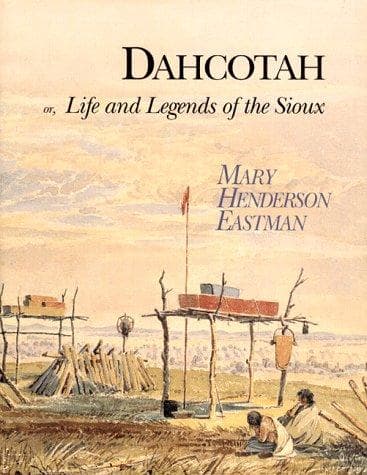
Dahcotah: Life and Legends of the Sioux Around Fort SnellingEastman, Mary H. (Mary Henderson)
History
Dahcotah: Life and Legends of the Sioux Around Fort Snelling
Eastman, Mary H. (Mary Henderson)
Dakota Indians -- Folklore; Dakota Indians -- History; Dakota Indians -- Social life and customs
No one would suppose but that the beaver-woman would have been grateful
to her husband for thinking of her. Instead of that, she was very angry;
and, taking her child in her arms, she left the lodge. Chaskè was
astonished to see his gentle wife angry, but he concluded he would eat
his supper, and then follow her, hoping that in the meantime she would
recover her good temper.
When he went out, she was nowhere to be seen. He called her--he thought
at first that she had hid herself. But, as night came on, and neither
she nor the child returned, the deserted husband grew desperate; he
could not stay in his lodge, and the only thing that he could do was to
start in search of her.
He walked all night, but saw no trace of her. About sunrise he came to a
stream, and following it up a little way he came to a beaver dam, and on
it sat his wife with her child in her arms. And beautiful she looked,
with her long tresses falling into the water.
Chaskè was delighted to find her. "Why did you leave me?" called he. "I
should have died of grief if I had not found you."
"Did I not tell you that I could not live like the Dahcotah women?"
replied Mocassin Flower. "You need not have watched me to find out what
I eat. Return to your own people; you will find there women enough who
eat venison."
The little boy clapped his hands with delight when he saw his father,
and wanted to go to him; but his mother would not let him. She tied a
string to his leg and told him to go, and the child would plunge into
the water, and when he had nearly reached the shore where his father
sat, then would the beaver-woman draw him back.
In the meantime the Dahcotah had been trying to persuade his wife to
come to him, and return to the lodge; but she refused to do so, and sat
combing her long hair. The child had cried itself to sleep; and the
Dahcotah, worn out with fatigue and grief, thought he would go to
sleep too.
After a while a woman came and touched him on the shoulder, and awaked
him as of old. He started and looked at her, and perceiving it was not
his wife, felt inclined to take little notice of her.
"What," said she, "does a Dahcotah warrior still love a woman who hates
him?"
"Mocassin Flower loves me well," replied the Dahcotah; "she has been a
good wife."
"Yes," replied the woman, "she was for a time; but she sighs to return
home--her heart yearns towards the lover of her youth."
Chaskè was very angry. "Can this be true?" he said; and he looked
towards the beaver dam where his wife still sat. In the meantime the
woman who had waked him, brought him some food in bark dishes worked
with porcupine.
"Eat," she said to the Dahcotah; "you are hungry."
But who can tell the fury that Mocassin Flower was in when she saw that
strange woman bringing her husband food. "Who are you," she cried, "that
are troubling yourself about my husband? I know you well; you are the
'Bear-Woman.'"
Public-domain text, read in full here on John Shaqi.
Reviews
Reviews
No reviews yet
Be the first to share your thoughts on this work.
Elsewhere in the archive
Join the Discussion
Join the discussion
Sign in to leave a comment or review.
Sign InorCreate an account