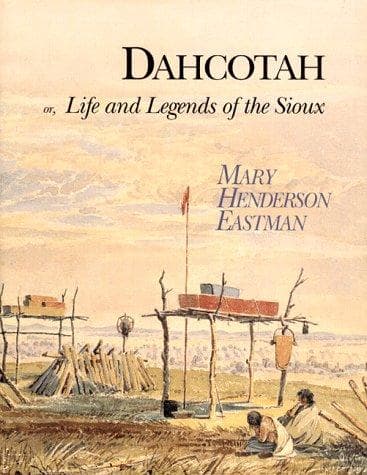
Dahcotah: Life and Legends of the Sioux Around Fort SnellingEastman, Mary H. (Mary Henderson)
History
Dahcotah: Life and Legends of the Sioux Around Fort Snelling
Eastman, Mary H. (Mary Henderson)
Dakota Indians -- Folklore; Dakota Indians -- History; Dakota Indians -- Social life and customs
He was certainly, what all the Chippeways have been, a friend of the
white people, and equally an enemy to the Dahcotahs. He encouraged all
attempts that were made towards the civilization of his people; he tried
to induce them to cultivate the ground; indeed, he sometimes assumed the
duties which among savages are supposed to belong exclusively to
females, and has been frequently seen to work in his garden. Had it been
possible, he would even have forced the Chippeways to civilization.
He had three wives--all sisters. He was fond of them, but if they
irritated him, by disputing among themselves, or neglecting any thing
which he found necessary to his comfort, he was very violent. Blows were
the only arguments he used on such occasions.
The present chief is one of his children; several of them died young,
and their father felt their loss most keenly. Grave and stoical as was
his deportment, his feelings were very strong, and not easily
controlled.
He was a man of deep thought, and of great ambition. The latter passion
was gratified to as great a degree as was possible. Loved by his tribe,
feared by his enemies, respected and well treated by the white people,
what more could a savage ask? Among the Indians he was a great man, but
he was truly great in cunning and deceit.
On this occasion, however, the Dahcotahs had perfect confidence in him,
and it was on the first day of April, in the same year, that they
arrived at the place appointed to meet the Chippeways, near the east
branch of the Chippeway river, about thirty miles northeast of Lac qui
parle. The women raised the teepees, six in number, and prepared the
scanty portion of food for their families. Here they remained, until
their patience was almost exhausted, constantly expecting
Hole-in-the-Day to appear; but day after day passed, and they were still
disappointed. Now and then the reports of fire-arms were heard near
them, but still the Chippeways did not visit the camp of the Dahcotahs.
Famine now showed itself among them. They had neither corn nor flour.
Had the wild ducks flown over their heads in clouds, there was but
little powder and shot to kill them--but there were few to be seen. Some
of the Indians proposed moving their camp where game was more
plenty--where they might see deer, and use their bows and arrows to some
purpose. But others said, if they were not at the appointed place of
meeting, they would violate the contract, and lose their claim to the
articles that Hole-in-the-day had promised to deliver to them.
It was finally concluded that the party should divide, one half moving
off in search of food, the other half remaining where they were, in
hopes that Hole-in-the-Day would make his appearance.
Public-domain text, read in full here on John Shaqi.
Reviews
Reviews
No reviews yet
Be the first to share your thoughts on this work.
Elsewhere in the archive
Join the Discussion
Join the discussion
Sign in to leave a comment or review.
Sign InorCreate an account