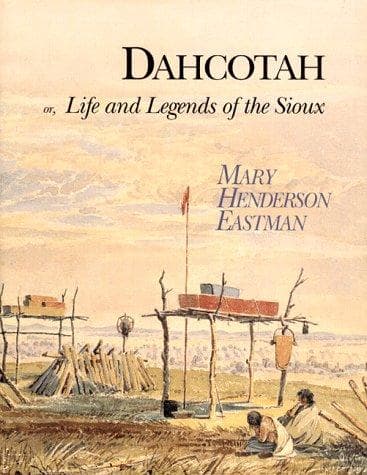
Dahcotah: Life and Legends of the Sioux Around Fort SnellingEastman, Mary H. (Mary Henderson)
History
Dahcotah: Life and Legends of the Sioux Around Fort Snelling
Eastman, Mary H. (Mary Henderson)
Dakota Indians -- Folklore; Dakota Indians -- History; Dakota Indians -- Social life and customs
"Come then and take her life. Let me see the brave warrior who will take
the life of my prisoner? Come! she is here; why do you, not raise your
tomahawks? It is easy to take a woman's scalp."
Not a warrior moves. The prisoner looks at the chief and at his
warriors. Hole-in-the-Day leads her from the council and points to his
teepee, which is again her home, and where she is as safe as she would
be in her husband's teepee, by the banks of the Mine So-to.
CHAPTER IV.
While the wife of Red Face lived from day to day in suspense as to her
fate, her husband made every effort for her recovery. Knowing that she
was still alive, he could not give up the hope of seeing her again.
Accordingly, the facts were made known at Fort Snelling, and the
Chippeway interpreter was sent up to Hole-in-the-Day's village, with an
order from the government to bring her down.
She had been expected for some time, when an excitement among a number
of old squaws, who were standing outside of the gate of the fort, showed
that something unusual was occasioning expressions of pleasure; and as
the wife of Red Face advanced towards the house of the interpreter,
their gratification was raised to the utmost.
Red Face and some of the Dahcotah warriors were soon there too--and the
long separated husband and wife were again united.
But whatever they might have felt on the occasion of meeting again, they
showed but little joy. Red Face entered the room where were assembled
the Indians and the officers of the garrison. He shook hands with the
officers and with the interpreter, and, without looking at his wife,
took his seat with the other Dahcotahs.
But her composure soon left her. When she saw him enter, the blood
mantled in her pale cheek--pale with long anxiety and recent fatigue.
She listened while the Dahcotahs talked with the agent and the
commanding officer; and at last, as if her feelings could not longer be
restrained, she arose, crossed the room, and took her seat at his feet!
The chief Hole-in-the-Day has been dead some years, and, in one of the
public prints, it was stated that he was thrown from his carriage and
killed. This was a genteel mode of dying, which cannot, with truth, be
attributed to him.
He always deplored the habit of drinking, to which the Indians are so
much addicted. In his latter years, however, he could not withstand the
temptation; and, on one occasion, being exceedingly drunk, he was put
into an ox-cart, and being rather restive, was thrown out, and the cart
wheel went over him.
Thus died Hole-in-the-Day-one of the most noted Indians of the present
day; and his eldest son reigns in his stead.
[Illustration: HAOKAH THE ANTI-NATURAL GOD; ONE OF THE GIANTS OF THE
DAHCOTAHS. Drawn by White Deer, a Sioux Warrior who lives near Fort
Snelling.]
EXPLANATION OF THE DRAWING.
Public-domain text, read in full here on John Shaqi.
Reviews
Reviews
No reviews yet
Be the first to share your thoughts on this work.
Elsewhere in the archive
Join the Discussion
Join the discussion
Sign in to leave a comment or review.
Sign InorCreate an account