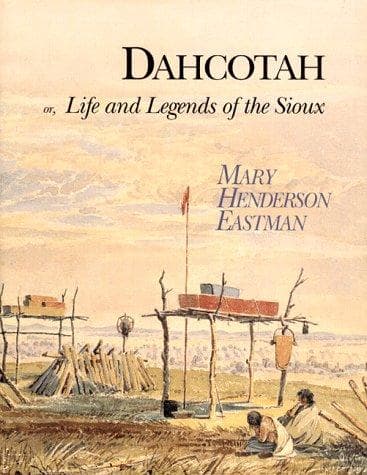
Dahcotah: Life and Legends of the Sioux Around Fort SnellingEastman, Mary H. (Mary Henderson)
History
Dahcotah: Life and Legends of the Sioux Around Fort Snelling
Eastman, Mary H. (Mary Henderson)
Dakota Indians -- Folklore; Dakota Indians -- History; Dakota Indians -- Social life and customs
A heavier cloud hangs about her heart than that which darkens nature.
She fears not the thunder, nor sees the angry lightning. She has laid
upon the scaffold her youngest son, the last of the many ties that bound
her to earth.
One week before, her son entered the wigwam. He was not alone; his
comrade, "The Hail that Strikes," accompanied him.
Harpstenah had been tanning deer-skin near her door. She had planted two
poles firmly in the ground, and on them she had stretched the deer-skin.
With an iron instrument she constantly scraped the skin, throwing water
upon it. She had smoked it too, and now it was ready to make into
mocassins or leggins. She had determined, while she was tanning the
deer-skin, how she would embroider them. They should be richer and
handsomer even than those of their chief's son; nay, gayer than those
worn by the chief himself. She had beads and stained porcupine quills;
all were ready for her to sew.
The venison for the evening meal was cooked and placed in a wooden bowl
before the fire, when the two young men entered.
The son hardly noticed his mother's greeting, as he invited his friend
to partake of the venison. After eating, he filled his pipe, smoked, and
offered it to the other. They seemed inclined to waste but little time
in talking, for the pipe was put by, and they were about to leave the
teepee, when the son's steps were arrested by his mother's asking him if
he were going out again on a hunt. "There is food enough," she added,
"and I thought you would remain at home and prepare to join in the dance
of the sun, which will be celebrated to-morrow. You promised me to do
so, and a Dahcotah values his word."
The young man hesitated, for he loved his mother, and he knew it would
grieve her to be told the expedition upon which he was going.
The eyes of his comrade flashed fire, and his lip curled scornfully, as
he turned towards the son of Harpstenah. "Are you afraid to tell your
mother the truth," he said, "or do you fear the 'long knives' [Footnote:
Officers and soldiers are called long knives among the Sioux, from their
wearing swords.] will carry you a prisoner to their fort? _I_ will tell
you where we are going," he added. "The Dahcotahs have bought us
whiskey, and we are going to meet them and help bring it up. And now
cry--you are a woman--but it is time for us to be gone."
The son lingered--he could not bear to see his mother's tears. He knew
the sorrows she had endured, he knew too (for she had often assured him)
that should harm come to him she would not survive it. The knife she
carried in her belt was ready to do its deadly work. She implored him to
stay, calling to his mind the deaths of his father and of his murdered
brothers; she bade him remember the tears they had shed together, and
the promises he had often made, never to add to the trials she
had endured.
Public-domain text, read in full here on John Shaqi.
Reviews
Reviews
No reviews yet
Be the first to share your thoughts on this work.
Elsewhere in the archive
Join the Discussion
Join the discussion
Sign in to leave a comment or review.
Sign InorCreate an account