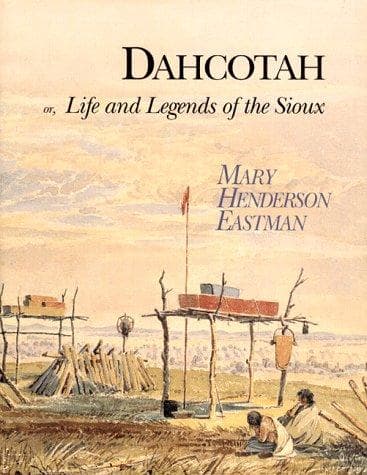
Dahcotah: Life and Legends of the Sioux Around Fort SnellingEastman, Mary H. (Mary Henderson)
History
Dahcotah: Life and Legends of the Sioux Around Fort Snelling
Eastman, Mary H. (Mary Henderson)
Dakota Indians -- Folklore; Dakota Indians -- History; Dakota Indians -- Social life and customs
"You promise me you will never bring another wife to your wigwam.
Deer-killer! the wife of the white man is happy, for her husband loves
her alone. The children of the second wife do not mock the woman who is
no longer beloved, nor strike her children before her eyes. When I am
your wife I shall be happy while you love me; there will be no night in
my teepee while I know your heart is faithful and true; but should you
break your word to me, and bring to your lodge another wife, you shall
see me no more, and the voice whose sound is music to your ears you will
never hear again."
Promises come as readily to the lips of an Indian lover as trustfulness
does to the heart of the woman who listens to them; and the Deer-killer
was believed.
Wanska had been often at the Fort, and she had seen the difference
between the life of a white and that of an Indian woman. She had thought
that the Great Spirit was unmindful of the cares of his children.
And who would have thought that care was known to Wanska, with her merry
laugh, and her never-ceasing jokes, whether played upon her young
companions, or on the old medicine man who kept everybody but her in
awe of him.
She seemed to be everywhere too, at the same time. Her canoe dances
lightly over the St. Peter's, and her companions try in vain to keep up
with her. Soon her clear voice is heard as she sings, keeping time with
the strokes of the axe she uses so skilfully. A peal of laughter rouses
the old woman, her mother, who goes to bring the truant home, but she is
gone, and when she returns, in time to see the red sun fade away in the
bright horizon, she tells her mother that she went out with two or three
other girls, to assist the hunters in bringing in the deer they had
killed. And her mother for once does not scold, for she remembers how
she used to love to wander on the prairies, when her heart was as light
and happy as her child's.
When Wanska was told that the Deer-killer loved Wenona, no one heard her
sighs, and for tears, she was too proud to shed any. Wenona's fault had
met with ridicule and contempt; there was neither sympathy nor excuse
found for her. And now that the Deer-killer had slighted Wenona, and had
promised to love her alone, there was nothing wanting to her happiness.
Bright tears of joy fell from her eyes when her lover said there was a
spell over him when he loved Wenona, but now his spirit was free; that
he would ever love her truly, and that when her parents returned he
would bring rich presents and lay them at the door of the lodge.
Wanska was indeed "the Merry Heart," for she loved the Deer-killer more
than life itself, and life was to her a long perspective of brightness.
She would lightly tread the journey of existence by his side, and when
wearied with the joys of this world, they would together travel the road
that leads to the Heaven of the Dahcotahs.
Public-domain text, read in full here on John Shaqi.
Reviews
Reviews
No reviews yet
Be the first to share your thoughts on this work.
Elsewhere in the archive
Join the Discussion
Join the discussion
Sign in to leave a comment or review.
Sign InorCreate an account