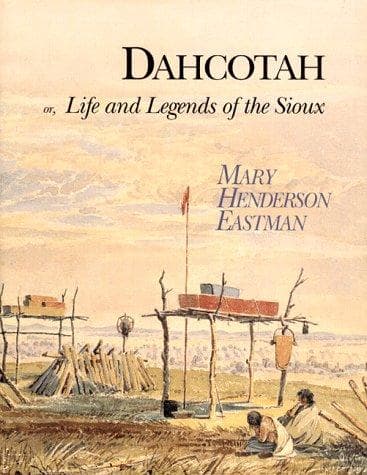
Dahcotah: Life and Legends of the Sioux Around Fort SnellingEastman, Mary H. (Mary Henderson)
History
Dahcotah: Life and Legends of the Sioux Around Fort Snelling
Eastman, Mary H. (Mary Henderson)
Dakota Indians -- Folklore; Dakota Indians -- History; Dakota Indians -- Social life and customs
She was safe in the next village, telling the Shield how much she loved
him, and how cordially she hated the Bear; and although she trembled
when she spoke of the medicine men, her husband only laughed at her
fears, telling her, that now that she was his wife, she need
fear nothing.
But where was the Swan? Her friends were assisting, in the search for
Sacred Wind. The father had forgotten his child, the brother his sister.
And the mother, who would have first missed her, had gone long ago, to
the land of spirits.
The Swan had known of the flight of the lovers--she watched them as
their canoe passed away, until it became a speck in the distance, and in
another moment the waters closed over her.
Thus were strangely blended marriage and death. The Swan feared not to
take her own life. Sacred Wind, with a nobler courage, a more devoted
love, broke through the customs of her nation, laid aside the
superstitions of the tribe, and has thus identified her courage with the
name of her native village.
"THE DAHCOTAH BRIDE."
The valley of the Upper Mississippi presents many attractions to the
reflecting mind, apart from the admiration excited by its natural
beauty. It is at once an old country and a new--the home of a people who
are rapidly passing away--and of a nation whose strength is ever
advancing. The white man treads upon the footsteps of the Dahcotah--the
war dance of the warrior gives place to the march of civilization--and
the saw-mill is heard where but a few years ago were sung the deeds of
the Dahcotah braves.
Years ago, the Dahcotah hunted where the Mississippi takes its rise--the
tribe claiming the country as far south as St. Louis. But difficulties
with the neighboring tribes have diminished their numbers and driven
them farther north and west; the white people have needed their lands,
and their course is onward. How will it end? Will this powerful tribe
cease to be a nation on the earth? Will their mysterious origin never be
ascertained? And must their religion and superstitions, their customs
and feasts pass away from memory as if they had never been?
Who can look upon them without interest? hardly the philosopher--surely
not the Christian. The image of God is defaced in the hearts of the
savage. Cain-like does the child of the forest put forth his hand and
stain it with a brother's blood. But are there no deeds of darkness done
in our own favored land?
Public-domain text, read in full here on John Shaqi.
Reviews
Reviews
No reviews yet
Be the first to share your thoughts on this work.
Elsewhere in the archive
Join the Discussion
Join the discussion
Sign in to leave a comment or review.
Sign InorCreate an account