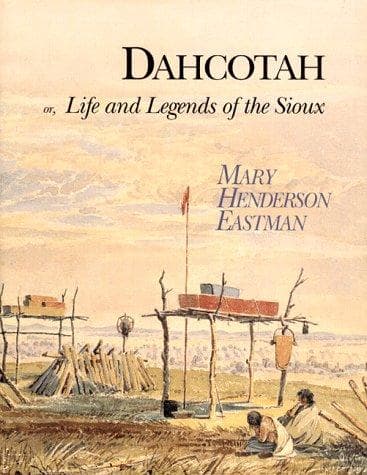
Dahcotah: Life and Legends of the Sioux Around Fort SnellingEastman, Mary H. (Mary Henderson)
History
Dahcotah: Life and Legends of the Sioux Around Fort Snelling
Eastman, Mary H. (Mary Henderson)
Dakota Indians -- Folklore; Dakota Indians -- History; Dakota Indians -- Social life and customs
He watched with interest the trials of strength between the young men of
his own tribe and the Dahcotahs. When the latter celebrated one of their
national feasts, when they ate the heart of the dog while it was warm
with life, just torn from the animal, with what contempt did he gaze
upon them!
[Illustration: FALLS OF ST. ANTHONY.]
The amusements of the dog feast, or dance, have closed, and the
Chippeway chief has signified to his warriors that they were to return
home on the following day. He expressed a wish to see several of the
chiefs of the Dahcotahs, and a meeting having been obtained, he thus
addressed them--
"Warriors! it has been the wish of our great father that we should be
friends; blood enough has been shed on both sides. But even if we
preferred to continue at war, we must do as our great father says. The
Indian's glory is passing away; they are as the setting sun; while the
white man is as the sun rising in all his power. We are the falling
leaves; the whites are the powerful horses that trample them under foot.
We are about to return home, and it is well that nothing has happened to
occasion strife between us. But I wish you to know that there are two
young men among us who do not belong to my band. They are pillagers,
belonging to another band, and they may be troublesome. I wish you to
tell your young men of this, that they may be on their guard."
After smoking together, the chiefs separated. "Hole in the Day" having
thus done all that he deemed proper, returned with his warriors to
his teepee.
Early in the morning the Chippeways encamped near St. Anthony's falls;
the women took upon themselves all the fatigue and labor of the journey,
the men carrying only the implements of war and hunting. The Chippeway
chief was the husband of three wives, who were sisters; and, strange to
say, when an Indian fancies more than one wife, he is fortunate if he
can obtain sisters, for they generally live in harmony, while wives who
are not related are constantly quarreling; and the husband does not
often interfere, even if words are changed to blows.
In the mean time, the two pillagers were lurking about; now remaining a
short time with the camp of the Chippeways, now absenting themselves for
a day or two. But while the Chippeways were preparing to leave the
Falls, the pillagers were in the neighborhood of Fort Snelling. They had
accompanied Hole in the Day's band, with the determination of killing an
enemy. The ancient feud still rankled in their hearts; as yet they had
had no opportunity of satisfying their thirst for blood; but on this
morning they were concealed in the bushes, when Red Boy and Beloved
Hail, two Dahcotahs, were passing on horseback. It was but a moment--and
the deed was done. Both the Chippeways fired, and Beloved Hail fell.
Red Boy was wounded, but not badly; he hurried in to tell the sad news,
and the two Chippeways were soon out of the power of their enemies. They
fled, it is supposed, to Missouri.
Public-domain text, read in full here on John Shaqi.
Reviews
Reviews
No reviews yet
Be the first to share your thoughts on this work.
Elsewhere in the archive
Join the Discussion
Join the discussion
Sign in to leave a comment or review.
Sign InorCreate an account