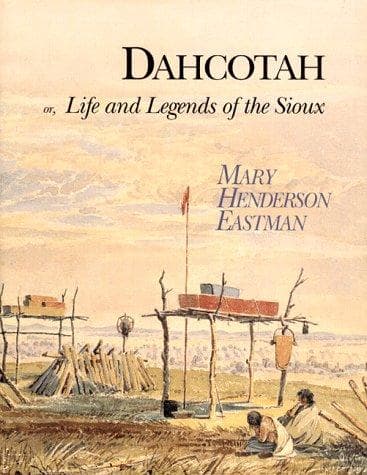
Dahcotah: Life and Legends of the Sioux Around Fort SnellingEastman, Mary H. (Mary Henderson)
History
Dahcotah: Life and Legends of the Sioux Around Fort Snelling
Eastman, Mary H. (Mary Henderson)
Dakota Indians -- Folklore; Dakota Indians -- History; Dakota Indians -- Social life and customs
When all was settled between the young people, War Club told his parents
that he wanted to marry. The old people were glad to hear it, for they
like their ancient and honorable names and houses to be kept up, just as
well as lords and dukes do; so they collected everything they owned for
the purpose of buying Walking Wind. Guns and blankets, powder and shot,
knives and trinkets, were in requisition instead of title-deeds and
settlements. So, when all was ready, War Club put the presents on a
horse, and carried them to the door of Walking Wind's wigwam.
He does not ask for the girl, however, as this would not be Dahcotah
etiquette. He lays the presents on the ground and has a consultation,
or, as the Indians say, a "talk" with the parents, concluding by asking
them to give him Walking Wind for his wife.
And, what is worthy to be noticed here is, that, after having gone to so
much trouble to ask a question, he never for a moment waits for an
answer, but turns round, horse and all, and goes back to his wigwam.
The parents then consult for a day or two, although they from the first
moment have made up their minds as to what they are going to do. In due
time the presents are taken into the wigwam, which signifies to the
lover that he is a happy man. And on the next day Walking Wind is to
be a bride.
CHAPTER V.
Early in the morning, Walking Wind commenced her toilet--and it was no
light task to deck the Indian bride in all her finery.
Her mocassins were worked with porcupine, and fitted closely her small
feet; the leggins were ornamented with ribbons of all colors; her cloth
shawl, shaped like a mantilla, was worked with rows of bright ribbons,
and the sewing did honor to her own skill in needle-work. Her breast
was covered with brooches, and a quantity of beads hung round her neck.
Heavy ear-rings are in her ears--and on her head is a diadem of war
eagle's feathers. She has a bright spot of vermilion on each cheek,
and--behold an Indian bride!
When she is ready, as many presents as were given for her are collected
and put on a horse; and the bride, accompanied by three or four of her
relations, takes the road to the wigwam of the bridegroom.
When they arrive within a hundred yards of the wigwam, Walking Wind's
father calls for the War Club to come out. He does not come, but sends
one of his relations to receive the bride. Do not suppose that Walking
Wind's father takes offence at the bridegroom's not coming when he is
called; for it is as much a part of the ceremony, among the Dahcotahs,
for one of the bride's relations to call for the bridegroom, and for the
groom to refuse to come, as it is for us to have the ring put upon the
third finger of the left hand.
As soon as the warrior deputed by the husband elect to receive the bride
makes his appearance, the Indians raise a shout of applause, and all run
towards him as he approaches them, and while they are running and
shouting they are firing off their guns too.
Public-domain text, read in full here on John Shaqi.
Reviews
Reviews
No reviews yet
Be the first to share your thoughts on this work.
Elsewhere in the archive
Join the Discussion
Join the discussion
Sign in to leave a comment or review.
Sign InorCreate an account