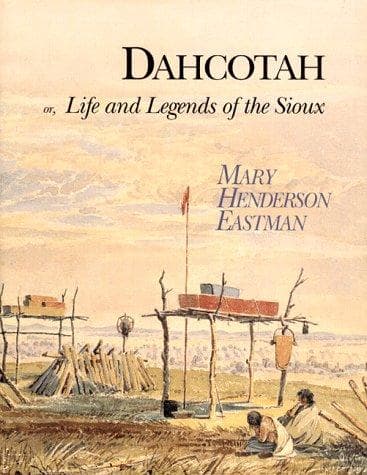
Dahcotah: Life and Legends of the Sioux Around Fort SnellingEastman, Mary H. (Mary Henderson)
History
Dahcotah: Life and Legends of the Sioux Around Fort Snelling
Eastman, Mary H. (Mary Henderson)
Dakota Indians -- Folklore; Dakota Indians -- History; Dakota Indians -- Social life and customs
How happily the day passed--how few such days occur in the longest
life!
As Shah-co-pee's village appeared in sight, the chief addressed Col.
D----, who was at that time in command of Fort Snelling, asking him why
we had come on such an excursion.
"To escort you home" was the ready reply; "you are a great chief, and
worthy of being honored, and we have chosen this as the best way of
showing our respect and admiration of you."
The Dahcotah chief believed all; he never for a moment thought there was
anything like jesting on the subject of his own high merits; his face
beamed with delight on receiving such a compliment.
The men and women of the village crowded on the shore as the boat
landed, as well they might, for a steamboat was a new sight to them.
The chief sprang from the boat, and swelling with pride and self
admiration he took the most conspicuous station on a rock near the
shore, among his people, and made them a speech.
We could but admire his native eloquence. Here, with all that is wild in
nature surrounding him, did the untaught orator address his people. His
lips gave rapid utterance to thoughts which did honor to his feelings,
when we consider who and what he was.
He told them that the white people were their friends; that they wished
them to give up murder and intemperance, and to live quietly and
happily. They taught them to plant corn, and they were anxious to
instruct their children. "When we are suffering," said he, "during the
cold weather, from sickness or want of food, they give us medicine
and bread."
And finally he told them of the honor that had been paid him. "I went,
as you know, to talk with the big Captain of the Fort, and he, knowing
the bravery of the Dahcotahs, and that I was a great chief, has brought
me home, as you see. Never has a Dahcotah warrior been thus honored!"
Never indeed! But we took care not to undeceive him. It was a harmless
error, and as no efforts on our part could have diminished his self
importance, we listened with apparent, indeed with real admiration of
his eloquent speech. The women brought ducks on board, and in exchange
we gave them bread; and it was evening as we watched the last teepee of
Shah-co-pee's village fade away in the distance.
But sorrow mingles with the remembrance of that bright day. One of those
who contributed most to its pleasures is gone from us--one whom all
esteemed and many loved, and justly, for never beat a kinder or a
nobler heart.
CHAPTER III.
Shah-co-pee has looked rather grave lately. There is trouble in the
wigwam.
The old chief is the husband of three wives, and they and their children
are always fighting. The first wife is old as the hills, wrinkled and
haggard; the chief cares no more for her than he does for the stick of
wood she is chopping. She quarrels with everybody but him, and this
prevents her from being quite forgotten.
Public-domain text, read in full here on John Shaqi.
Reviews
Reviews
No reviews yet
Be the first to share your thoughts on this work.
Elsewhere in the archive
Join the Discussion
Join the discussion
Sign in to leave a comment or review.
Sign InorCreate an account