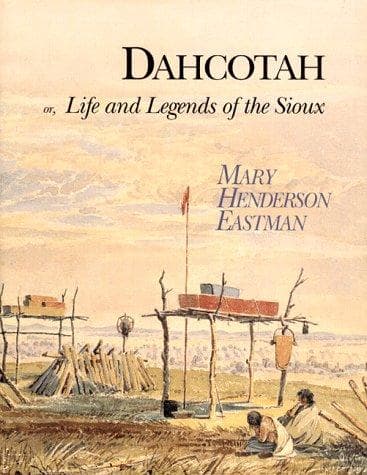
Dahcotah: Life and Legends of the Sioux Around Fort SnellingEastman, Mary H. (Mary Henderson)
History
Dahcotah: Life and Legends of the Sioux Around Fort Snelling
Eastman, Mary H. (Mary Henderson)
Dakota Indians -- Folklore; Dakota Indians -- History; Dakota Indians -- Social life and customs
The Track-maker entered the canoe first, and the girl followed; and so
pleasant was the task of paddling her lover over the quiet waters, that
it seemed but a moment before they were in sight of the torrent.
"It was there," said the Sioux, "that Wenona and her child found their
graves. Her husband, accompanied by some other Dahcotahs, had gone some
distance above the falls to hunt. While there, he fell in love with a
young girl whom he thought more beautiful than his wife. Wenona knew
that she must no longer hope to be loved as she had been.
"The Dahcotahs killed much game, and then broke up their camp and
started for their homes. When they reached the falls, the women got
ready to carry their canoes and baggage round.
"But Wenona was going on a longer journey. She would not live when her
husband loved her no more, and, putting her son in her canoe, she soon
reached the island that divides the falls.
"Then she put on all her ornaments, as if she were a bride; she dressed
her boy too, as a Dahcotah warrior; she turned to look once more at her
husband, who was helping his second wife to put the things she was to
carry, on her back.
"Soon her husband called to her; she did not answer him, but placed her
child high up in the canoe, so that his father could see him, and
getting in herself she paddled towards the rapids.
"Her husband saw that Unk-tahe would destroy her, and he called to her
to come ashore. But he might have called to the roaring waters as well,
and they would have heeded him as soon as she.
"Still he ran along the shore with his arms uplifted, entreating her to
come ashore.
"Wenona continued her course towards the rapids--her voice was heard
above the waters as she sang her death song. Soon the mother and child
were seen no more--the waters covered them.
"But her spirit wanders near this place. An elk and fawn are often seen,
and we know they are Wenona and her child."
"Do you love me as Wenona loved?" continued the Sioux, as he met the
looks of the young girl bent upon him.
"I will not live when I see you no more," she replied. "As the flowers
die when the winter's cold falls upon them, so will my spirit depart
when I no longer listen to your voice. But when I go to the land of
spirits I shall be happy. My spirit will return to earth; but it will be
always near you."
Little didst thou dream that the fate of Wenona would be less sad than
thine. She found the death she sought, in the waters whose bosom opened
to receive her. But thou wilt bid adieu to earth in the midst of the
battle--in the very presence of him, for whose love thou wouldst venture
all. Thy spirit will flee trembling from the shrieks of the dying
mother, the suffering child. Death will come to thee as a terror, not
as a refuge.
CHAPTER II.
When the Chippeways broke up their camp near Fort Snelling, they divided
into two parties, one party returning home by the Mississippi, the other
by way of the St. Croix.
Public-domain text, read in full here on John Shaqi.
Reviews
Reviews
No reviews yet
Be the first to share your thoughts on this work.
Elsewhere in the archive
Join the Discussion
Join the discussion
Sign in to leave a comment or review.
Sign InorCreate an account