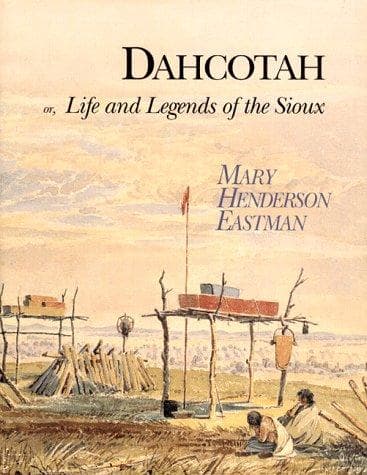
Dahcotah: Life and Legends of the Sioux Around Fort SnellingEastman, Mary H. (Mary Henderson)
History
Dahcotah: Life and Legends of the Sioux Around Fort Snelling
Eastman, Mary H. (Mary Henderson)
Dakota Indians -- Folklore; Dakota Indians -- History; Dakota Indians -- Social life and customs
The shrieks of the dying women reached the ears of their husbands and
brothers. Quickly did they retrace their steps, and when they reached
the spot, they bravely stood their ground; but the Dahcotahs were too
powerful for them,--terrible was the struggle!
The Dahcotahs continued the slaughter, and the Chippeways were obliged
at last to give way. One of the Chippeways seized his frightened child
and placed him upon his back. His wife lay dead at his feet; with his
child clinging to him, he fought his way through.
Two of the Dahcotahs followed him, for he was flying fast; and they
feared he would soon be out of their power. They thought, as they nearly
came up to him, that he would loose his hold on his child; but the
father's heart was strong within him. He flies, and the Sioux are close
upon his heels! He fires and kills one of them. The other Sioux follows:
he has nothing to encumber him--he must be victor in such an unequal
contest. But the love that was stronger than death nerved the father's
arm. He kept firing, and the Sioux retreated. The Chippeway and his
young son reached their home in safety, there to mourn the loss of
others whom they loved.
The sun set upon a bloody field; the young and old lay piled together;
the hearts that had welcomed the breaking of the day were all
unconscious of its close.
The Sioux were avenged; and the scalps that they brought home (nearly
one hundred when the party joined them from the massacre at Saint Croix)
bore witness to their triumph.
The other party of Sioux followed the Chippeways who had gone by way of
the St. Croix. While the Chippeways slept, the war-cry of the Sioux
aroused them. And though they fought bravely, they suffered as did their
friends, and the darkness of night added terror to the scene.
The Dahcotahs returned with the scalps to their villages, and as they
entered triumphantly, they were greeted with shouts of applause. The
scalps were divided among the villages, and joyful preparations were
made to celebrate the scalp-dance.
The scalps were stretched upon hoops, and covered with vermilion,
ornamented with feathers, ribbons and trinkets.
On the women's scalps were hung a comb, or a pair of scissors, and for
months did the Dahcotah women dance around them. The men wore mourning
for their enemies, as is the custom among the Dahcotahs.
When the dancing was done, the scalps were buried with the deceased
relatives of the Sioux who took them.
And this is Indian, but what is Christian warfare? The wife of the hero
lives to realize her wretchedness; the honors paid by his countrymen are
a poor recompense for the loss of his love and protection. The life of
the child too, is safe, but who will lead him in the paths of virtue,
when his mother has gone down to the grave.
Public-domain text, read in full here on John Shaqi.
Reviews
Reviews
No reviews yet
Be the first to share your thoughts on this work.
Elsewhere in the archive
Join the Discussion
Join the discussion
Sign in to leave a comment or review.
Sign InorCreate an account