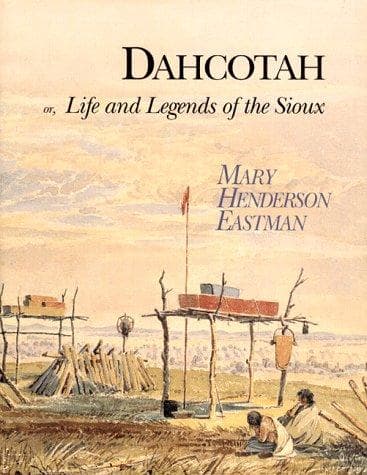
Dahcotah: Life and Legends of the Sioux Around Fort SnellingEastman, Mary H. (Mary Henderson)
History
Dahcotah: Life and Legends of the Sioux Around Fort Snelling
Eastman, Mary H. (Mary Henderson)
Dakota Indians -- Folklore; Dakota Indians -- History; Dakota Indians -- Social life and customs
The children have hardly strength to stand; the father places one upon
his back and goes forward; the mother wraps her dead child in her
blanket, and lays it in the snow; another is clinging to her, she has no
time to weep for the dead; nature calls upon her to make an effort for
the living. She takes her child and follows the rest. It would be a
comfort to her, could she hope to find her infant's body when summer
returns to bury it. She shudders, and remembers that the wolves of the
prairie are starving too!
Food is found at last; the strength of the buffalo yields to the arrow
of the Sioux. We will have food and not die, is the joyful cry of all,
and when their fierce appetites are appeased, they carry with them on
their return to their village, the skins of the animals with the
remainder of the meat.
The sufferings of famine and fatigue, however, are followed by those of
disease; the strength of many is laid low. They must watch, too, for
their enemies are at hand.
CHAPTER III.
In the summer of 1844 a large party of half-breeds and Indians from Red
river,--English subjects,--trespassed upon the hunting grounds of the
Sioux. There were several hundred hunters, and many carts drawn by oxen
for the purpose of carrying away the buffalo they had killed. One of
this party had left his companions, and was riding alone at some
distance from them. A Dahcotah knew that his nation would suffer from
the destruction of their game--fresh in his memory, too, were the
sufferings of the past winter. What wonder then that the arrow which was
intended for the buffalo, should find its way to the heart of the
trespasser!
This act enraged the half-breeds; they could not find the Sioux who
committed it--but a few days after they fell in with a party of others,
who were also hunting, and killed seven of them. The rest escaped, and
carried the news of the death of their braves to their village. One of
the killed was a relative of Sullen Face. The sad news spread rapidly
through the village, and nothing was heard but lamentation. The women
cut long gashes on their arms, and as the blood flowed from the wound
they would cry, Where is my husband? my son? my brother?
Soon the cry of revenge is heard above that of lamentation. "It is not
possible," said Sullen Face, "that we can allow these English to starve
us, and take the lives of our warriors. They have taken from us the food
that would nourish our wives and children; and more, they have killed
seven of our bravest men! we will have revenge--we will watch for them,
and bring home their scalps, that our women may dance round them!"
A war party was soon formed, and Sullen Face, at the head of more than
fifty warriors, stationed himself in the vicinity of the road by which
the half-breeds from Red river drive their cattle to Fort Snelling.
Public-domain text, read in full here on John Shaqi.
Reviews
Reviews
No reviews yet
Be the first to share your thoughts on this work.
Elsewhere in the archive
Join the Discussion
Join the discussion
Sign in to leave a comment or review.
Sign InorCreate an account