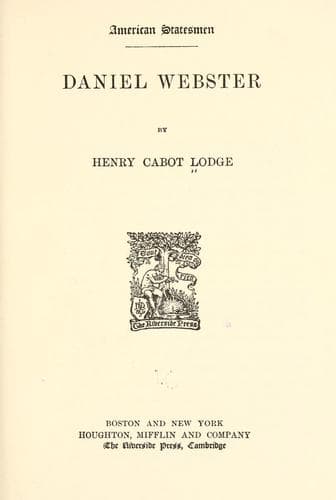
Legislators -- United States -- Biography; United States -- Politics and government -- 1815-1861; Webster, Daniel, 1782-1852
He showed the same indifference to the source of supplies of money in other
ways. He took a fee from Wheelock, and then deserted him. He came down to
Salem to prosecute a murderer, and the opposing counsel objected that he
was brought there to hurry the jury beyond the law and the evidence, and it
was even murmured audibly in the court-room that he had a fee from the
relatives of the murdered man in his pocket. A fee of that sort he
certainly received either then or afterwards. Every ugly public attack that
was made upon him related to money, and it is painful that the biographer
of such a man as Webster should be compelled to give many pages to show
that his hero was not in the pay of manufacturers, and did not receive a
bribe in carrying out the provisions of the treaty of Guadaloupe-Hidalgo.
The refutation may be perfectly successful, but there ought to have been no
need of it. The reputation of a man like Mr. Webster in money matters
should have been so far above suspicion that no one would have dreamed of
attacking it. Debts and subscriptions bred the idea that there might be
worse behind, and although there is no reason to believe that such was the
case, these things are of themselves deplorable enough.
When Mr. Webster failed it was a moral failure. His moral character was not
equal to his intellectual force. All the errors he ever committed, whether
in public or in private life, in political action or in regard to money
obligations, came from moral weakness. He was deficient in that intensity
of conviction which carries men beyond and above all triumphs of
statesmanship, and makes them the embodiment of the great moral forces
which move the world. If Mr. Webster's moral power had equalled his
intellectual greatness, he would have had no rival in our history. But this
combination and balance are so rare that they are hardly to be found in
perfection among the sons of men. The very fact of his greatness made his
failings all the more dangerous and unfortunate. To be blinded by the
splendor of his fame and the lustre of his achievements and prate about the
sin of belittling a great man is the falsest philosophy and the meanest
cant. The only thing worth having, in history as in life, is truth; and we
do wrong to our past, to ourselves, and to our posterity if we do not
strive to render simple justice always. We can forgive the errors and
sorrow for the faults of our great ones gone; we cannot afford to hide or
forget their shortcomings.
Public-domain text, read in full here on John Shaqi.
Reviews
Reviews
No reviews yet
Be the first to share your thoughts on this work.
Elsewhere in the archive
Join the Discussion
Join the discussion
Sign in to leave a comment or review.
Sign InorCreate an account