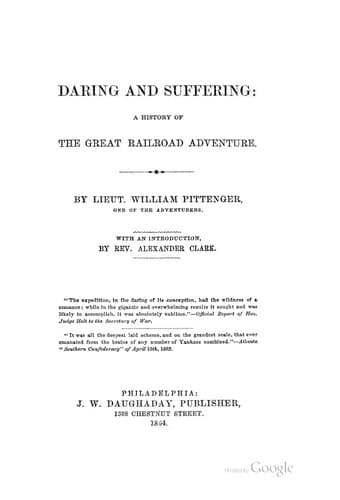
Daring and Suffering: A History of the Great Railroad AdventurePittenger, William
History
Daring and Suffering: A History of the Great Railroad Adventure
Pittenger, William
Chattanooga Railroad Expedition, 1862; United States -- History -- Civil War, 1861-1865 -- Campaigns
Still persevering, I wrote the names of several books on a slip of
paper, and gave it to Chillis, the commissary, who wanted us hung when
we first came, but who was, nevertheless, the kindest official of the
prison; he likewise returned it, saying that _none_ of the books named
were to be found. I then yielded, and reserved my money for the next
best purpose to which it could be applied--to buy bread, which I often
needed. We could at first get small cakes for ten cents apiece; but
they afterward rose to fifteen. We had to take postage stamps in
change, and, having no pocket-book to carry them in, they would often
become torn and cracked, which rendered them worthless. Thus we lost a
considerable portion of our precious money.
We soon became very restless and discontented here, and revolved
desperate plans of escape. It seemed like a hopeless prospect, for we
were in the third story, and could only escape by passing at each door
through successive relays of guards, all of which had a reserve ready
to cooeperate with them in case of alarm. Our room was next to the
jailor's office, and on the opposite side was a row of rooms
containing all kinds of prisoners. The one next to us was occupied by
a number of Federal soldiers--some charged with being spies, and
others with murder.
One of the latter was Captain Webster. He was a young and most
handsome man, not over twenty-two years of age. He had, on one
occasion, been sent to take a notorious guerilla captain, named
Simpson, who was then hiding within our lines. When he was found,
Webster summoned him to surrender. Instead of doing so he fired his
pistol and started to run; but Webster also fired, and mortally
wounded him.
When Webster was subsequently taken prisoner, he was held for the
_murder_ of Simpson, and confined in the room next to us. The charge I
have repeatedly heard, not only from himself and fellow prisoners, but
from the officers of the prison. Judge of my surprise, then, on
reading, since my return home, of the hanging of Webster for
_violating his parole_. This being a charge that the law of war would
visit with death, the Confederates _officially lied_ in substituting
the one charge for the other, in order to justify themselves, and
prevent retaliation.
Public-domain text, read in full here on John Shaqi.
Reviews
Reviews
No reviews yet
Be the first to share your thoughts on this work.
Elsewhere in the archive
Join the Discussion
Join the discussion
Sign in to leave a comment or review.
Sign InorCreate an account