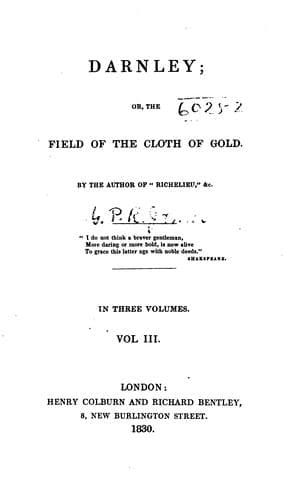
Darnley; or, The Field of the Cloth of GoldJames, G. P. R. (George Payne Rainsford)
History
Darnley; or, The Field of the Cloth of Gold
James, G. P. R. (George Payne Rainsford)
Great Britain -- History -- Henry VIII, 1509-1547 -- Fiction; Henry VIII, King of England, 1491-1547 -- Fiction
The place to which Sir Osborne Maurice was conveyed, when the
servants, according to their master's commands, removed him from the
book-room, was a large dark chamber, running along beneath the whole
extent of the principal stair-case, and some way into one of the
towers beyond. The old manor-house--which for many reasons Sir Payan
still inhabited, even after dispossessing Lord Fitzbernard of Chilham
Castle--although built of brick, in a more modern style than the
ancient holds of the feudal nobility, had not entirely abandoned the
castellated architecture formerly in use. Here and there, upon the
long front of the building, was fastened a large square tower, useless
as a defence, and inconvenient as a dwelling; and at every angle
appeared an imposthume-like watch-turret, of redder brick than the
rest, like carbuncles upon the face of a drunkard. The curse of small
windows also was upon the house, making it look as sombre without as
it was dark within, and the thick leafless wood that swept round it on
both sides excluded great part of that light which might otherwise
have found its way into the gloomy mansion.
Darker than all the rest was the chamber to which Sir Osborne Maurice
was conveyed; the whole of that part which was under the stair-case,
receiving no light whatever, except from the other half, that, placed
in one of the square towers, possessed the privilege of an unglazed
window near the ceiling. It would be difficult to say for what purpose
this chamber was originally contrived; but it is probable that at the
time the house was built (during the contentions of York and
Lancaster), such rooms might be necessary, even in private houses,
both as places of strength and concealment, although too weak to
resist long attack, and too easy of discovery to afford any very
secure lurking-place. The use to which Sir Payan Wileton applied it
was in general that of a prison for deer-stealers and other offenders
who came before him in his magisterial capacity, which offenders he
took care should ever be as numerous as there were persons of the
lower orders who opposed or displeased him.
Public-domain text, read in full here on John Shaqi.
Reviews
Reviews
No reviews yet
Be the first to share your thoughts on this work.
Join the Discussion
Join the discussion
Sign in to leave a comment or review.
Sign InorCreate an account