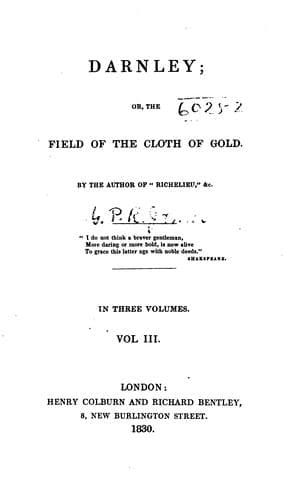
Darnley; or, The Field of the Cloth of GoldJames, G. P. R. (George Payne Rainsford)
History
Darnley; or, The Field of the Cloth of Gold
James, G. P. R. (George Payne Rainsford)
Great Britain -- History -- Henry VIII, 1509-1547 -- Fiction; Henry VIII, King of England, 1491-1547 -- Fiction
The men who conducted the young knight shut the door immediately upon
him; and thus being left to ruminate over his fate, with his arms
still tightly pinioned behind him, and scarcely light sufficient to
distinguish any objects which the room contained, it may well be
conceived that his meditations were not of the most pleasant
description. But, nevertheless, indignation had roused his spirit, and
he no longer felt that depression of mind, and abandonment of hope,
which for a time had overpowered him. His first thoughts, therefore,
were now of escape and revenge, but for the moment no means presented
themselves of either; and though he searched round the apartment,
ascertaining the nature and extent of his prison, which only consisted
of that room and a large closet containing some straw, no chance
whatever of flight from thence presented itself, and he was obliged to
wait in hopes of circumstances proving his friend.
In about half an hour, the voice of Sir Payan Wileton was heard
without, giving various orders, and a moment after, the trampling of
horses sounded as if passing by the window. To Sir Osborne, accustomed
for several years to watch with warlike acuteness every motion of a
shrewd and active enemy, these sounds gave notice that his persecutor
was gone for the time, and even the circumstance of his absence
excited in the bosom of the young knight fresh expectation of some
favourable opportunity.
Hardly had Sir Payan departed, when the lock, which might well have
fastened the door of an antediluvian giant, squeaked harshly with the
key; and the tall fellow, whom we have denominated hitherto, and shall
still continue to denominate Longpole, entered, and pushed the door
behind him.
"The devil's gone out on horseback," said he, coming near Sir Osborne,
and speaking low, "and I have just got a minute to thank your
worship."
"To thank me, my friend!" said Sir Osborne, somewhat doubting the
man's meaning; "for what should you thank me?"
"For throwing the man over a hedge that struck my father," said
Longpole, "and by that I see you are a true heart and a gentleman--and
a knight into the bargain, I am sure, in spite of all Sir Payan's
tales, and his minion's false swearing; and if I were not his sworn
servant I'd let you off this minute, if I could find a way."
"But is it not much worse to aid in so black a plot as this than to
leave this vile suborner, who is not your born master, and never can
be lawfully, if you be the son of old Richard Heartley? Only hear me."
"Nay, sir knight," said Longpole; "faith I must not hear you, for I
must mind my oath, and do as I'm bid, though it be the devil bids me.
I only came to thank you, before I brought the other prisoner here,
and to tell you, that though I have forgotten and forgiven many hard
knocks, I never forget a good turn, and that you'll find, whatever you
may think now. Every dog has his day, but the dog-days don't last all
the year."
Public-domain text, read in full here on John Shaqi.
Reviews
Reviews
No reviews yet
Be the first to share your thoughts on this work.
Join the Discussion
Join the discussion
Sign in to leave a comment or review.
Sign InorCreate an account