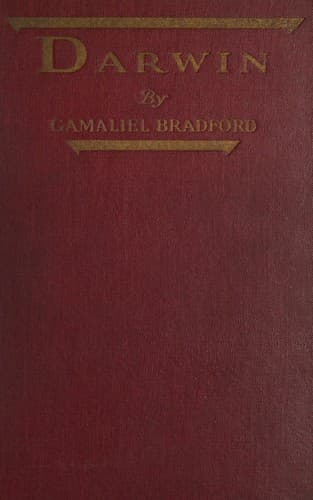
Darwin, Charles, 1809-1882; Naturalists -- England -- Biography
Evolution, idea and D.’s explanation of process, 4; controversy, 6;
acceptance of principle, 6, 121, 125; effect on study of natural
history, 40-43; as term, 83; before Darwin, 83-85, 101, 233; theory
of inheritance of acquired characters, D. and, 85, 87; D. and
predecessors, 85-88; beginning of D.’s interest, 88; his development
of theory of natural selection, 89-91; his statement of theory, 91;
his realization of influence of theory, 92, 209-13; his years of
study and experiment, 92, 93; Wallace and presentation of theory,
93, 94; D. and Wallace, 94, 95; _Origin of Species_, its effect, 96;
D.’s attitude toward, as achievement, 99-101, 122-24; attacks by
scientists, 102; religious attacks, 103; D. and attacks, 104-08; D.
and other workers, 109; D. and difficulties, 111-17; D.’s revisions,
118; modification of theory, 119-21, 124; promulgators, 121; effect
on theology, 209; D.’s caution in statement, 212; D. and ethical
standards under theory, 213; D. and effect on belief, 215, 216;
D. and belief in God, 216-18; and atheism, 218-20; as typifying
scientific influence on life, 221; influence on politics, 222-25; and
realism, 225; and hell and heaven, 227; and popular belief in God and
worship, 229, 230; and substitute for sin, 231-33; philosophical,
233-35; clerical harmonizing with religion, 236; Fundamentalists
and, 237, 282; scientific harmonizing, 237-39; and individualism in
religious belief, 239, 240; future adjustment with religion, 240;
destructive spiritual effect, 241-47; self-contradictions in reason,
280.
Experiment, D.’s devotion, 5, 56; position, 55; equipment, 57; D.’s
thoroughness, 58; impersonality, 58; accuracy, repetition, 59;
recording, errors and successes, 61.
Exposition, D.’s power, 62-64; illustrations, 64-69.
Expression, D.’s study, 17-19.
Eye, and evolutionary theory, 112.
Fabre, J. H., and nature, 12.
Fame, as motive of achievement, 96-101.
Family, D. and father’s memory, 190; D. as fiancé, 190-92; husband
and wife, 192-96; children, training, 196-201; their assistance, 200.
Farrer, Sir Thomas, on D.’s detailed observation, 26.
Fichte, J. H. von, and evolution, 233.
Fiction, D.’s attitude, 145.
Financial condition, D.’s, 184; his attitude and care, 185; his
generosity, 186.
Finney, C. G., on revival, 230.
Fiske, John, and evolution, 122, 241.
France, Anatole, effect of evolution on, 242.
Friendship, D.’s trait, 201, 202; his influence over friends, 202;
his dependence, 203; his services to friends, 204-07.
Fun, D.’s trait, 172.
Fundamentalism, attacks on evolution, 103, 282; ethical attitude,
232; theological attitude, 237.
Gautier, Théophile, on observation, 7; as poet, 11.
Generosity, D.’s trait, 186.
George, Henry D. and _Progress and Poverty_, 137.
Gladstone, W. E., and D., 133.
God, D.’s attitude, 164-67; influence of evolution on belief, 216-18,
229; thirst for, 285.
Public-domain text, read in full here on John Shaqi.
Reviews
Reviews
No reviews yet
Be the first to share your thoughts on this work.
Elsewhere in the archive
Join the Discussion
Join the discussion
Sign in to leave a comment or review.
Sign InorCreate an account