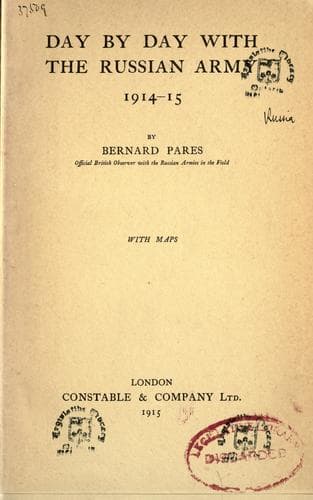
Day by Day with the Russian Army, 1914-15Pares, Bernard
History
Day by Day with the Russian Army, 1914-15
Pares, Bernard
World War, 1914-1918 -- Campaigns -- Poland; World War, 1914-1918 -- Personal narratives, English
We drove off to the officers' mess, which was in a large cottage. At
the crowded tables there reigned the spirit of brotherhood. After the
Emperor's toast the colonel and the regiment drank to King George and
England, and all stood waving their glasses and roaring hurrah, while
I went round and touched glasses with each. My toast was that the
alliance should last on after the war. We had other toasts, the sisters
of mercy, the colonel's wife, and above all the regiment. It was well
on in the early morning when the young officers on horseback escorted
their guests back to the town.
On Easter Sunday some of the Red Cross people went out to the front.
At this point both sides had agreed not to shoot, and the men came out
of their trenches and fraternised across the Dunajec, the Russians
producing a harmonium. Newspapers were exchanged; and an Austrian
officer sat down and wrote some impromptu verses, which he fastened to
a stone and threw across. The verses began very peaceably, but had an
unexpected end which, my friends felt, would be specially interesting
to me. I give them in German with a translation--
Auf Grund der hohen Feier tage
Geändert unsere Feindeslage.
Wir leben heut' in tiefem Frieden:
Zur kürzen Zeit ist's uns beschieden,
Dann werden wir die Waffen mässen;
Jedoch soll niemals man vergessen
Den Stifter deiser Weltenbrand.
"Gott Strafe England."
The holy days of Easter-tide
Have set our enmity aside.
We live in perfect peace to-day:
'Tis but a little time we may,
Then to our weapons we must get;
But ever we'll remember yet
Who lit this fire of world-wide wrack;
O God, pay England back.
_April 9._
I have been visiting my friends at the Staff of the army at Jaslo. Even
this place has not been immune, bombs have been thrown from aeroplanes,
doing no damage to the army but wounding and killing some children.
I visited the General in command, who is in splendid spirits. He is the
simplest of men, and stops in the streets to talk to the children or to
any new arrival. He is happy now, because things are going forward.
The Staff lies in rather better quarters here, but with the same
simplicity as when I first visited it at Pilsno. One of the regiments
I knew came through in fine style with its colonel at its head; it
had done forty-eight miles in two days, and was ready for any amount
more. The different battalions were singing different soldiers' songs,
each taking pride in getting a good swing and putting in the best foot
forward. I was struck with one man who marched at the side leading the
songs with a mouth like a brass instrument and a voice to match.
Two German airmen have just come down here. They had made a wide
circuit, and were brought down by the failure of their motor. As always
here, they are being well treated. Even in the case of spies caught
red-handed, it is most difficult to get the Russian soldier to shoot,
especially if the condemned shows any sign of fear.
Public-domain text, read in full here on John Shaqi.
Reviews
Reviews
No reviews yet
Be the first to share your thoughts on this work.
Elsewhere in the archive
Join the Discussion
Join the discussion
Sign in to leave a comment or review.
Sign InorCreate an account