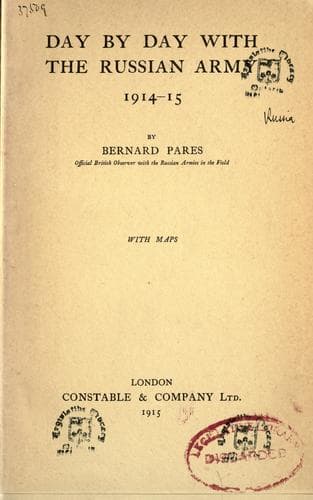
Day by Day with the Russian Army, 1914-15Pares, Bernard
History
Day by Day with the Russian Army, 1914-15
Pares, Bernard
World War, 1914-1918 -- Campaigns -- Poland; World War, 1914-1918 -- Personal narratives, English
But the task in the Carpathians is a stupendous one, and it comes when
the Russian army has been tried to the full by the tremendous work
which it has already gone through. We had in England no adequate army
when the war began; we had not reckoned on the shameless violation of
Belgian territory or on the obligations of a joint struggle with allies
for the independence of Europe. Every one in Russia understands the
miracle that we have done in creating so rapidly a really competent
continental army on the basis of volunteer service, and every one sees
that we were right to defer our blow till the great new instrument
was whole and perfected. But it is Russia who has given us time for
preparing our action on land; and the sacrifices which this has cost
her are heavy indeed. The tremendous impact at Rava Ruska was followed
by another prolonged and exterminating effort on the San, and this
takes no account of the work which was done in holding the furious
attacks of the main enemy in Russian Poland. These efforts put a
terrible drain on the Russian resources. While we stood firm on the
west, whole Russian regiments were almost annihilated in the victorious
storming of one Austrian position after another. In my earlier visits
to regiments I have often asked how many men of the first call still
remain; sometimes only six of a company were still left, sometimes
it was hardly more out of a whole regiment. It was an army already
replaced at almost every point which had to attempt the conquest of the
Carpathians.
The Carpathians are not the Alps. It might be easier if they were, for
there would be fewer positions capable of being defended. They are a
belt of high and higher hills some sixty miles or more in breadth,
where whole armies can hold line after line. They are full of trees,
water and mud. Only one double line of railway runs through them.
As they have the shape of a fan spread northwards, the defence can
concentrate backward along the various converging passes and can, in
a relatively small space, almost block the narrow entrance to the
Hungarian plain. But once that final barrier is passed, Hungary is
lost. Any counter advance can be blocked without great expenditure
of forces, and the conqueror will be free to advance southwards or
westwards.
_April 12._
At the Staff of the Army I fell in with a number of casual
acquaintances who all saluted me as "Mister." There was a keen young
flying-man who was now going back to his cavalry regiment, and a
colonel sent to take temporary command of an infantry regiment. The
talk was in fragments and all of incidents of camp life or engagements.
We knew that another advance had been made and that big things were
going forward.
Public-domain text, read in full here on John Shaqi.
Reviews
Reviews
No reviews yet
Be the first to share your thoughts on this work.
Elsewhere in the archive
Join the Discussion
Join the discussion
Sign in to leave a comment or review.
Sign InorCreate an account