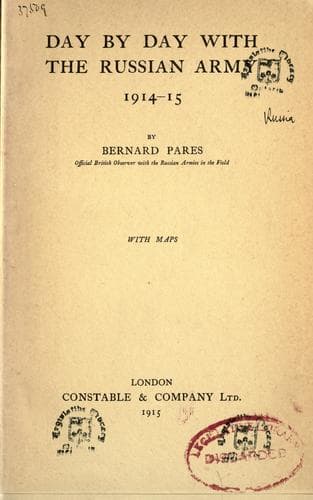
Day by Day with the Russian Army, 1914-15Pares, Bernard
History
Day by Day with the Russian Army, 1914-15
Pares, Bernard
World War, 1914-1918 -- Campaigns -- Poland; World War, 1914-1918 -- Personal narratives, English
A young sentry came in, saluted the regimental flag, and mounted guard
over it, his face settling at once into a fixed stare. When I woke the
next morning, the man, his pose and his stare were still the same.
Along the drenched road and fields came numberless batches of blue
Austrian uniforms, prisoners, usually escorted only by one brown
Russian. I had a lot of talk with some of these. "_Miserabel_" was
their word for their condition before capture. All were sick of the
war, "even the Hungarians now, though at first they liked it." "The
main thing," said one, "is that people should not go on killing each
other: nothing else counts. As to territory, it's all one to me to what
State my home belongs; I only want to earn my living." "When you hear
that in Russia," I said, "you will have the kind of peace that you ask
for, but I don't think you ever will."
The colonel came back with his staff, drenched through, even to
the case of his field-glass, but jubilant. After the rest came a
middle-aged officer with his head bound up, and that gentle look which
accompanies head wounds. He said in a conversational voice "Hurrah" and
sat down. Some one asked him of his wound; and he simply answered, "Oh,
that's nothing."
_April 16._
I have been to see one of the first regiments which I visited, in its
new surroundings. When I was first with the H's, they were maintaining
ground under difficulties. They were opposite a notable and commanding
height, which could sweep the Russian line with a cross-fire or lodge
bombs among the H's at short range. I remember in particular a visit
to an exposed part of the trenches in company with two officers, one a
fair-haired florid young man who sniped at stray Austrians, the other
also young, but dark and sallow, evidently not strong, to whom this
part of the front had been entrusted. When I said I should like to
visit it, he said, "You'll be killed"; and when I rather pointlessly
said, "That is interesting," he replied, "No, it is not interesting."
He struck me and others as bearing a hard burden, and bearing it well.
I remember the fair young man sniping at the enemy, and also dealing
with a soldier who asked to be sent to the rear. "What's his wound?
That's not much." "Yes, but he has a wife and three children." "Then I
should say he is one of those who ought to stay: he has seen a bit of
life."
Public-domain text, read in full here on John Shaqi.
Reviews
Reviews
No reviews yet
Be the first to share your thoughts on this work.
Elsewhere in the archive
Join the Discussion
Join the discussion
Sign in to leave a comment or review.
Sign InorCreate an account