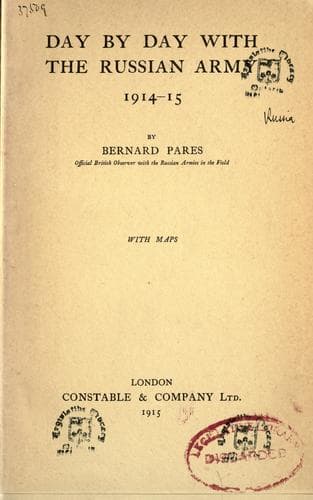
Day by Day with the Russian Army, 1914-15Pares, Bernard
History
Day by Day with the Russian Army, 1914-15
Pares, Bernard
World War, 1914-1918 -- Campaigns -- Poland; World War, 1914-1918 -- Personal narratives, English
I found the regimental staff, with the kindest of colonels, in an
armoured blockhouse that had guarded the railway tunnel between Hungary
and Galicia. I asked him after the two dead officers. The sallow young
man was not dead after all. He had led the storming of the Beskides
and was the first man into the trenches. "He saved the whole thing for
us," said the Colonel, "and I am presenting him for the Cross of St.
George."[1]
_April 17._
I started off from the General's on a journey of six miles, and I had
an object lesson in the difficulties of movement in this region. My
orderly, naturally, did not know the names of villages in this part,
and thus we found ourselves at a neighbouring station eight miles from
my destination. A train was due; but at any station on this line a long
halt may be necessary for the collection of all that must be forwarded,
whether troops or material. I spent the interval at a local Feeding
Point, where I had some acquaintances. Only a soldier-caretaker was
there, attending to a young scout-leader who had got a shrapnel wound.
At last the train moved off. I had made a couch of my wraps in a large
goods wagon; but I was the only passenger who travelled in comfort. The
others were private soldiers, and in the dark they talked freely, and
were entirely themselves. One of them was telling sad things of the
losses in his regiment, of how the telephone might have saved them,
but had broken down. "You won't manage in war without loss," said one
of the elder men. "No losses, no victory." Few as they were, his words
summed up the difference between sitting in trenches and making ground
by attack. They talked on; and as one often notices in these night
talks of the Russian privates, there was a kind of sacred simplicity,
which left one thinking. I recalled the Austrian private who did not
care what country his home belonged to as long as he earned his own
living.
Seven hours had passed since I left my starting-point, and I was still
a mile and a half from my destination. I decided to walk, and set out
along the railway. The night was dark, and the only light was from the
enemy's projectors. There were bridges over deep gullies that called
for caution; and every hundred yards or so I was hailed by a sentry;
one of them asked naïvely whether I was a Magyar. Anyhow, I reached the
station an hour and a half before the train; and in the half-smashed
station building I found first an ambulance room, and above it a little
band of devoted workers with whom I had lived at another part of the
front.
Public-domain text, read in full here on John Shaqi.
Reviews
Reviews
No reviews yet
Be the first to share your thoughts on this work.
Elsewhere in the archive
Join the Discussion
Join the discussion
Sign in to leave a comment or review.
Sign InorCreate an account