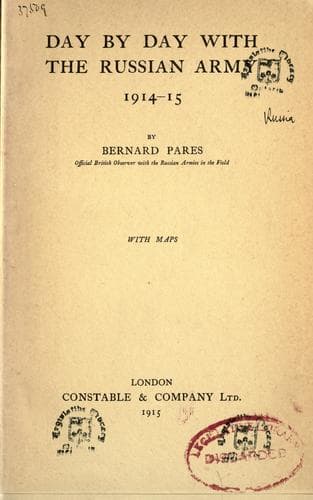
Day by Day with the Russian Army, 1914-15Pares, Bernard
History
Day by Day with the Russian Army, 1914-15
Pares, Bernard
World War, 1914-1918 -- Campaigns -- Poland; World War, 1914-1918 -- Personal narratives, English
An officer whom I met in the trenches, and of whom I wrote under the
name of "George," has very appropriately been appointed one of the
judges of recommendations for the George Cross. The soldier's George
is given for any signal act of bravery, and the men thus honoured
are always found to be the rallying points in further attacks. The
officers' George is in four classes. Only some four individuals have
ever received the first class, beginning with Kutuzov. The second
class, which is for very definite achievements of generalship can only
be given to Generals (Ivanov has it for the conquest of Galicia), and
the third only to Generals and Colonels. The fourth, which is for any
act of courage or initiative, can be won by any officer. The different
achievements which can win the George are clearly set out. The two
first classes are conferred only by the nomination of the Sovereign;
for the other two there is in each army what is called a "Duma," or
panel of selectors.
My friend, who is one of the bravest and simplest men that I have met,
told me very interesting things about his work. His own standard of
bravery is not striking acts of daring, but the maintenance of normal
composure in the performance of dangerous tasks. It is, I think, a
standard which will appeal to Englishmen. One of the most typical
instances of Russian courage that I know is among the records of the
battle of Borodino. An aide-de-camp galloped up to a commanding officer
and, pointing towards a hill, said: "The Commander-in-Chief asks you
to attack there." As he spoke, a cannon ball carried away his extended
arm; he simply pointed to the hill with the other, and said, "There: be
quick."
At many points of our line there has been a complete lull. One battery
which I visited, standing on some thickly wooded hills, was building a
wooden villa for the officers, and had already put up a camp theatre
for the performances of short plays written by the men. There was
little but the ordinary diversion of shooting at aeroplanes.
Prisoners continue to testify to the discontent in the enemy's armies.
For instance, an Alsatian says that any Alsatian would come over at the
first opportunity. A German says that the conditions in his regiment
are such that he would have shot himself but for regard for his family.
Czechs report further mutinies in their regiments which have been
punished with military executions. The Ruthenian regiments, which
cannot now be reinforced from Galicia, are rapidly melting away. Even
the Hungarian soldiers are described as desirous of peace.
_May 3._
Public-domain text, read in full here on John Shaqi.
Reviews
Reviews
No reviews yet
Be the first to share your thoughts on this work.
Elsewhere in the archive
Join the Discussion
Join the discussion
Sign in to leave a comment or review.
Sign InorCreate an account