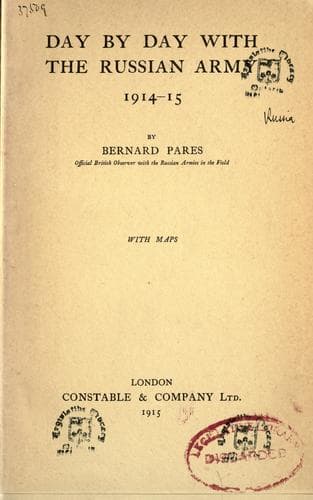
Day by Day with the Russian Army, 1914-15Pares, Bernard
History
Day by Day with the Russian Army, 1914-15
Pares, Bernard
World War, 1914-1918 -- Campaigns -- Poland; World War, 1914-1918 -- Personal narratives, English
The station is a wonderful place--as wonderful as the great station
in Lvov, which I described several months ago. It is crowded with
wounded, lying close together in the family manner of the Russian
peasant. Most are wounded in the hands or the head; this means that
they were under a devastating fire in the trenches which hit anything
that was at all exposed. But there are also many signs of advance or of
infantry attacks beaten off, in wounds of all kinds all over the body.
Every night hundreds of wounded are given clean bandages and fed with
anything that can be bought in a place where all is movement.
The officers lie here like the rest, separated only by the silent
respect shown to them by the men. The number of wounded officers is not
surprising, for, as I have explained, they stand and walk while their
men are ordered to crawl; but the sacrifice in officers is particularly
impressive.
For me the officers are also sources of information as to the fate of
each of the regiments I have visited. Four jolly N's, three of them
wounded, told me of how their trenches were levelled and how they
retired because there were only shell pits to sleep in; seven officers
led the last counter-attack of this regiment. Of some regiments the
news was that they were practically all gone; in one case the answer
was "The regiment does not exist." Some one asked of one of the O's
where his regiment was to be found: he answered "In the other world."
I learned that three hundred men of this regiment with the colonel had
fought their way back; later, I learned that only seventy-one were
left. The General of this Division told me that he had reformed and
reinforced his men and that they were again at the front, where he was
off to join them. The T's had invited me to join them when in action,
and it was a pure chance that I was directed to another point. I passed
in the street the field trains of this regiment; the officer riding at
the head stopped me and grasped my hand: "What I wanted to say," he
said, "is that the T's are gone, only the flag is saved." The next day
a private with the number of this regiment came up to me in the street:
would I come and see the Colonel who had just been brought in wounded?
I found him at the quarters of the Commander of the Army. His head was
bound up, but he was seated and writing. General Radko Dmitriev came
in and shook his hand time after time. "Thank you for your splendid
stand; human strength can do no more." The Colonel related that his
entrenchments were demolished with the men in them; one company was
cut off, and forty hands were held up in surrender; he himself saw
how the Germans bayoneted half the number out of hand; his own men,
when only five hundred were left of them, went on taking prisoners
exceeding themselves in number, and rejoiced in this sign of their
moral superiority. Of forty officers and four thousand men, in the end
two hundred and fifty were left.
Public-domain text, read in full here on John Shaqi.
Reviews
Reviews
No reviews yet
Be the first to share your thoughts on this work.
Elsewhere in the archive
Join the Discussion
Join the discussion
Sign in to leave a comment or review.
Sign InorCreate an account