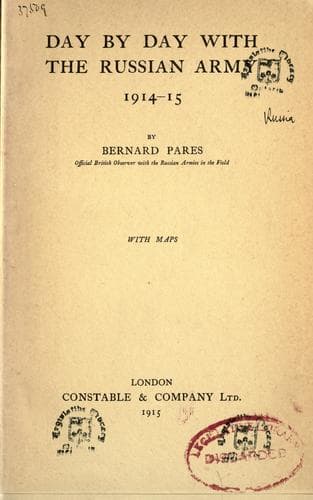
Day by Day with the Russian Army, 1914-15Pares, Bernard
History
Day by Day with the Russian Army, 1914-15
Pares, Bernard
World War, 1914-1918 -- Campaigns -- Poland; World War, 1914-1918 -- Personal narratives, English
On the day when I walked along the San, the enemy did not show
themselves in any force till the evening. Then and throughout the
night the tremendous cannonade that they had kept up all day became
more intense, and with the aid of the powerful German projectors the
area to the rear of the Russian lines was swept, especially at three
given points. Here in the evening the enemy crossed the narrow stream
in boats. The railway bridge was mined, but was left standing as long
as possible. An Austrian shell cut the train of the mine, without
exploding it, at a point forty yards on the Russian side of the river.
Masses of the enemy were already at the bridge when a Russian officer
and private went forward and made a new connexion, which they fired at
once. The bridge was blown into the air, and the two daring Russians
were sent flying by the shock, but remained alive.
At different points the enemy effected a lodgment on the eastern bank
and, where the Russian line was thinnest and held by regiments already
reduced to half or quarter strength in the previous fighting, the
trenches were partly occupied by the Germans or Austrians. Next morning
the Russians made vigorous counter attacks and recovered the ground
lost; but returning in overwhelming force, the enemy not only regained
his hold on the eastern bank but extended it on either flank and pushed
further eastwards.
There followed five days of very severe fighting. The issue at stake
was whether the enemy's successes could still be limited to western
Galicia--or, in other words, whether half or the whole of the territory
conquered by the Russians was now to be flooded by his armies. His
object was, of course, to find room eastward of the San for his
powerful forces and artillery. There were in all five German or
Austrian armies in the area chosen for the enemy's impact. Of these,
two were engaged with the Eighth Russian Army and three were opposed
to our Third Army; these last numbered nine army corps, including the
Reserve Corps of the Prussian Guard and two others which were drawn
from the French front. German heavy artillery, though apparently of a
different calibre from that employed at the beginning of the Galician
battle, took a prominent part in this fighting; and the Austrians
showed better marksmanship than at any period in the war.
Public-domain text, read in full here on John Shaqi.
Reviews
Reviews
No reviews yet
Be the first to share your thoughts on this work.
Elsewhere in the archive
Join the Discussion
Join the discussion
Sign in to leave a comment or review.
Sign InorCreate an account