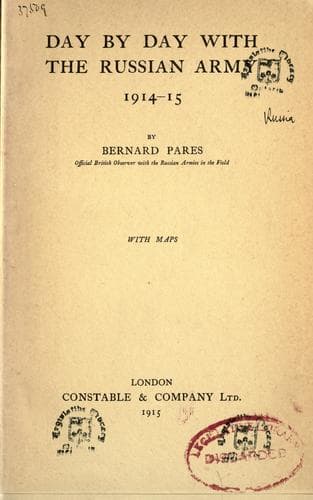
Day by Day with the Russian Army, 1914-15Pares, Bernard
History
Day by Day with the Russian Army, 1914-15
Pares, Bernard
World War, 1914-1918 -- Campaigns -- Poland; World War, 1914-1918 -- Personal narratives, English
At Kosienice, which saw some of the hardest fighting in the war, two
regiments crossed the Vistula--the Vistula, mind; and those who have
seen it will know what that means--under fire and in face of two German
corps and three Austrian; another brigade of 3 K came along the river
from a Russian fortress on the western bank, marching knee-deep through
marsh and water with the general at its head. The two regiments that
crossed moved forward to a vast forest near the river, and there they
had an hour and a half's bayonet fighting--one may imagine what that
means. An enormous number of officers went down; the B's lost forty,
and the S's in the course of those five days had seven successive
officers killed while commanding the regiment. In the midst of the
bayonet fighting, when most of the Russian officers fell, some of the
Germans shouted out in Russian, "Don't fight your own men!" and in the
confusion which followed the Russians left the forest and lay, half
in marsh and with only the most elementary cover, under a devastating
artillery fire; however, they held their ground on this bank of the
river, and, as soon as they were reinforced, they again moved forward
and scattered the Germans, drove them off westward, and then pushed the
Austrians, in more than a week of fighting, beyond Kielce, where they
feasted their triumph with the old corps song, "God has given victory."
After this followed arduous fighting in the Czenstochowa region. Later
the corps went to the eastern Carpathians to stem an Austro-German
advance, and it was thence brought rapidly across to the assistance
of our army when the tremendous artillery impact of the enemy fell on
Galicia between Gorlice and Tarnow.
I first saw General Irmanov the day he had entered Kielce. He is one
of the most remarkable and sympathetic figures of the whole war. I
saw what seemed an old man of middle height, of sturdy figure, with
a curious outward kink in his walk as of one who had lived much on
horseback; he has a singularly peaceful and gentle face, with a high
colour and grey hair and beard; a child-like simplicity and directness
blended with a fatherly benevolence; but the suggestion of different
ages ends, when one sees much of the General, in one's forgetting age
altogether. The voice is a mild, high one which sometimes comes out
like a little bark. I had a long talk then with General Irmanov, and
for every one of my questions got a clear and full answer. Irmanov was
not a General Staff officer; in peace and off duty he lives a quiet
domestic life in his mountain home. His staff is like a family; there
is a peculiar smartness and spirit in the salute when the General
appears and all line up to greet him. He mounts without delay and is
off in a moment; he is one of the fastest riders in the army, and in a
few minutes his suite, trained riders as they are, are all streaming
behind him.
Public-domain text, read in full here on John Shaqi.
Reviews
Reviews
No reviews yet
Be the first to share your thoughts on this work.
Elsewhere in the archive
Join the Discussion
Join the discussion
Sign in to leave a comment or review.
Sign InorCreate an account