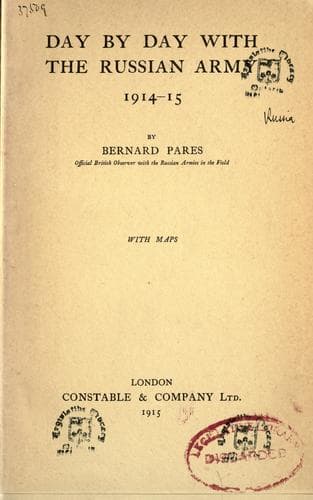
Day by Day with the Russian Army, 1914-15Pares, Bernard
History
Day by Day with the Russian Army, 1914-15
Pares, Bernard
World War, 1914-1918 -- Campaigns -- Poland; World War, 1914-1918 -- Personal narratives, English
The day after our ride there was nothing doing, and it was difficult
to make any plan. I spent most of the day lying about the big garden,
as many of the soldiers did. There were pleasant gullies, and beyond
lay the long, rambling, white-walled village with a pretty church. The
village girls were all on the way thither dressed in bright colours. It
seemed that there were services twice a day; and the people, who were
Poles, met whenever they heard the cannon, to pray for the success of
the Russian arms.
I sat for some time in the church. The younger girls all knelt before
the chancel and sang a long and beautiful prayer, into which, in the
second half of each stave, there joined the voices of the men behind.
Then the priest, who looked both kind and clever, had a talk with the
younger children. Poland is one of the few countries where all the
church music is congregational, and it is often sung very beautifully.
For the Pole the church is the fortress and shelter of his country;
and in this terrible war, which has fallen so hardly on Poland, this
comfort is more needed and more real than ever. It is many times that
the inhabitants of this region, especially old peasant women, have told
me how they feared the coming of the Germans.
The Staff was a very pleasant company. The chief, also a general, had
the face and manner of a conscientious English country gentleman; he
was widely read in military history, and his judgments were always
weighed. The senior adjutant had been contusioned and invalided, but
somehow had managed to return almost at once; he was humorous and
talkative; in his room he had a placard, "There is no air in this room,
don't spoil your health and GO AWAY." Over the General's door he had
written, "Don't disturb work or rest."
Two officers examined our prisoners, assisted by a Czech interpreter.
There was one very militant Austrian German, who would have it that
Austria would win; he was so rude about the Austrian Slavs that I asked
him at the end whether Austria wanted the Slavs. He said they wished
to be quit of Galicia, and in fact of all their Slav provinces; I
suggested that Austria proper and Tirol might find their natural place
inside the German empire; he answered with alacrity, "Of course, far
better under Wilhelm II." It is a view which offers possibilities of a
settlement; but I did not see how it would suit Austria.
In the evening the Cossacks, encamped in different groups in the wood,
struck up their strange songs and the Russian national hymn, which they
have their own way of singing, suggestive of cadences in the music of
the north of England. I came back from a walk in the cornfields to hear
that the General invited me to come with him the next day.
Public-domain text, read in full here on John Shaqi.
Reviews
Reviews
No reviews yet
Be the first to share your thoughts on this work.
Elsewhere in the archive
Join the Discussion
Join the discussion
Sign in to leave a comment or review.
Sign InorCreate an account