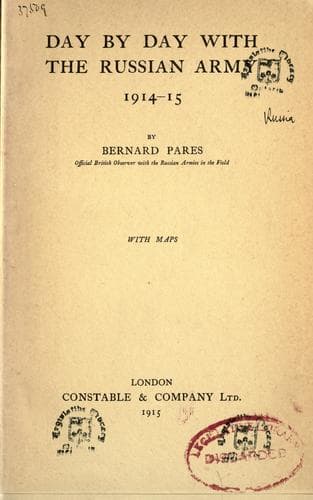
Day by Day with the Russian Army, 1914-15Pares, Bernard
History
Day by Day with the Russian Army, 1914-15
Pares, Bernard
World War, 1914-1918 -- Campaigns -- Poland; World War, 1914-1918 -- Personal narratives, English
[10] The numbers were enormous. In our interrogations we usually had
to distinguish between "Did you surrender?" and "Did you come across
of yourselves?" The mass surrenders of Austrians took the following
order in respect of nationalities: Serbians and Bosnians, Ruthenians,
Rumanians and Italians, Poles, Czechs, and later in lesser numbers,
Magyars, and Germans of Austria proper, last of all Tirolese; and
Croats, not at all.
[11] Evidently Austrian deserters.
[12] On our side there were always plenty of volunteers to catch "a
tongue," or person who could talk. No prizes were offered.
[13] This is typical of the mutual relations which I witnessed.
[14] These frequent references to officers going off to hospital
without mention of any wound or illness would be difficult to parallel
on the Russian side. One Russian officer's principle was "You may be
killed, but you mayn't be ill."
[15] Gorlice is the point from which later the Austro-German advance
began.
[16] The Russian soldiers cannot get any stimulants and Russian
officers very seldom. The Staff of our Army was teetotal throughout.
[17] The universal desire of all our Austrian prisoners, also of most
of the Germans.
[18] For Easter.
[19] There are throughout several references to the accuracy of the
Russian fire, which was nothing like so sporadic as the enemy's.
[20] A verdict given to me several times by Austrian prisoners. One of
our men escaped from the Honveds with his tongue cut out for not giving
information. I have seen old peasants who had been shot by the Honveds.
[21] This almost isolated reference to Russian prisoners is suggestive.
[22] The Austrian infantry seldom did so.
[23] I have seen nothing like this attitude on the Russian side, even
where our trenches were sixty or even twenty-five yards from those of
the enemy.
[24] For weeks before, the Austrian officers tried to keep up the
spirits of the men by this promise.
[25] About 240 heavy and 160 field artillery.
[26] This is the ordinary advance into an empty space when all trenches
and all life has been destroyed by the enemy's artillery.
[27] This circumspection should be noted; this is the day of one of the
greatest Russian losses.
[28] This was my general experience when retreating with the troops in
front of the writer.
[29] This was the state of Tuchow before all this fighting; there had
now been another terrible artillery canonnade.
[30] Austrian prisoners say that the hardest fighting is in Serbia.
[31] _Cf. supra_, p. 251.
TRANSCRIBER'S NOTES:
Text in italics is surrounded by underscores: _italics_.
Emboldened text is surrounded with equals signs: =bold=.
Obvious typographical errors have been corrected.
Inconsistencies in spelling, hyphenation, and punctuation have been
preserved.
End of the Project Gutenberg EBook of Day by Day With The Russian Army
1914-15, by Bernard Pares
Public-domain text, read in full here on John Shaqi.
Reviews
Reviews
No reviews yet
Be the first to share your thoughts on this work.
Elsewhere in the archive
Join the Discussion
Join the discussion
Sign in to leave a comment or review.
Sign InorCreate an account