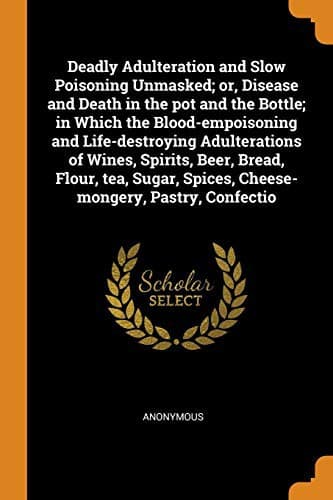
Deadly Adulteration and Slow Poisoning Unmasked: Disease and Death in the Pot and BottleAnonymous
Science
Deadly Adulteration and Slow Poisoning Unmasked: Disease and Death in the Pot and Bottle
Anonymous
Drug adulteration; Food adulteration and inspection
Where the damaged and ordinary green teas or tea leaves have been
prepared with japan earth, or other adulterating ingredients, for the
purpose of giving the leaves the colour, and the infusion the tincture
of bohea tea, the fraud may be detected by either of the following
tests or methods: 1. A less quantity of this dyed tea will give a
deeper colour to the same proportion of water than if the experimented
articles were genuine. 2. The colour it gives the water will also be of
a reddish brown, whereas, if the article be genuine, it should be dark.
3. When the leaves have been washed, by standing a little, they will
look greener than good bohea. 4. This dyed tea is generally much larger
than the genuine specimens; it is, therefore, always advisable to buy
the small leaved bohea; remembering to examine whether the ingenuity
of the artist has not been at work to break or crumble it into pieces,
so as to disguise the size of the leaves: for the adulterator’s wits
are always at work in “the black art.” 5. The liquor drawn off, which
should be smooth and balsamic to the palate, tastes rougher and harsher
than the genuine tea does. 6. If milk is poured into it, it will
rise of a reddish colour, instead of a dark or blackish brown. 7. A
little copperas put into this last-mentioned liquor will turn it to a
light blue, instead of a deep blue inclining to black. 8. Spirits of
hartshorn make good tea of a deep brownish colour, after it has stood
awhile, similar to new drawn tincture of saffron; but the same effect
does not appear when the tea is bad.
When green tea is counterfeited by dyeing bad bohea with green vitriol
the cheat may be detected by the following means: 1. By putting a piece
of gall into the infusion it will turn it to a deep blackish colour,
which would not be the case were vitriol or copperas not present.
2. If the infusion made of this tea be of a pale green, and incline
to a blueish dye, it is bad. 3. Spirit of hartshorn will give it a
slight purple tinge, and precipitate a small sediment, instead of a
deep greenish yellow after it has stood about half a dozen minutes.
4. Where the adulteration has been made with carbonate of copper,
the fraud is detected, by shaking up a tea-spoonful of the suspected
article in a phial with two tea-spoonsful of liquid ammonia, diluted
with half its bulk of water; when the liquor, if copper be present,
will exhibit a fine blue colour. Mr. Accum in his work, p. 219-221,
gives other methods for testing adulterated tea.
Public-domain text, read in full here on John Shaqi.
Reviews
Reviews
No reviews yet
Be the first to share your thoughts on this work.
Elsewhere in the archive
Join the Discussion
Join the discussion
Sign in to leave a comment or review.
Sign InorCreate an account