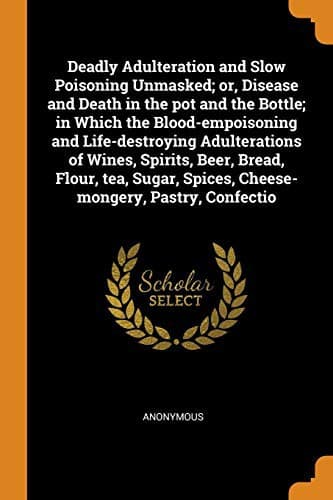
Deadly Adulteration and Slow Poisoning Unmasked: Disease and Death in the Pot and BottleAnonymous
Science
Deadly Adulteration and Slow Poisoning Unmasked: Disease and Death in the Pot and Bottle
Anonymous
Drug adulteration; Food adulteration and inspection
Vinegar is prepared from a variety of substances; but its common
preparations are from wine, fruits, malt, sugar, and wood. The vinegar
made from wood is the strongest, containing at least eight times the
strength of the common preparations. It is perfectly colourless, and
its taste is very pungent and grateful. But the vinegar generally
prepared for sale in this country is made from malt; which to be good
should be of a pale brown colour, perfectly transparent, of a pleasant
and rather pungent acid taste, but without acrimony, and a fragrant
grateful odour. These are the readiest and best tests of good vinegar.
But as a false strength is frequently given to it by adding oil of
vitriol, sulphuric acid, or the extract of some acrid vegetable, as
pellitory of Spain, capsicum, &c. or metallic extracts, the tests for
ascertaining these foreign substances are as follow: If it is suspected
that vinegar is adulterated with oil of vitriol, put three or four
drops of acetate of barytes into a glass of vinegar; filtrate the
white precipitate thereby produced through paper, and heat the powder
or residuum remaining in a tobacco-pipe until it is red hot. Then put
it into spirit of salt or diluted aqua-fortis; if the precipitate
dissolves, the vinegar is genuine; if not, it is adulterated. But if
metallic adulteration is suspected, add liquid ammonia to the vinegar,
until the odour of the ammonia predominates; if the mixture assumes
a blackish tint, it is a sign that copper is present in the article.
If the presence of lead be suspected, add water impregnated with
sulphuretted hydrogen to the suspected vinegar; if the mixture becomes
black or yields a black precipitate, your suspicion is well founded.
OLIVE, OR FLORENCE OIL.
Olive oil is frequently adulterated by mixing with it the oil of poppy
seeds or a decoction of cucumbers, which latter ingredients easily
unite with the oleaginous substances. It is frequently impregnated
with lead, from the circumstance of the fruit which yields the oil
being compressed between leaden plates, and the oil being suffered to
remain in pewter or leaden cisterns in order to become clear before
it is offered for sale. This last injurious quality is communicated
afresh to the commodity by the retail venders, who frequently keep a
pewter vessel immersed in the oil, for the purpose, as they assert, of
preserving the liquid from becoming rancid. It is however proper to
state that the metallic contamination by the wholesale manufacturer
chiefly belongs to the Spanish produce: the French and Italian
manufacture is usually free from the impregnation.
Public-domain text, read in full here on John Shaqi.
Reviews
Reviews
No reviews yet
Be the first to share your thoughts on this work.
Elsewhere in the archive
Join the Discussion
Join the discussion
Sign in to leave a comment or review.
Sign InorCreate an account