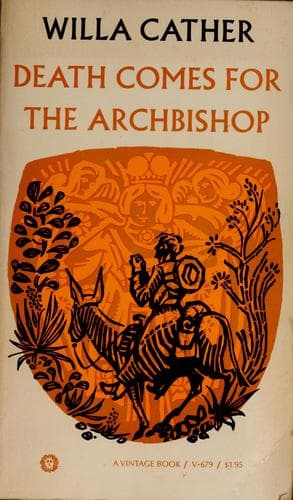
Christian fiction; Clergy -- Fiction; Historical fiction; New Mexico -- Fiction
The Bishop heard the old woman's confession. He blessed her and put both
hands upon her head. When he took her down the nave to let her out of
the church, Sada made to lift his cloak from her shoulders. He
restrained her, telling her she must keep it for her own, and sleep in
it at night. But she slipped out of it hurriedly; such a thought seemed
to terrify her. "No, no, Father. If they were to find it on me!" More
than that, she did not accuse her oppressors. But as she put it off, she
stroked the old garment and patted it as if it were a living thing that
had been kind to her.
Happily Father Latour bethought him of a little silver medal, with a
figure of the Virgin, he had in his pocket. He gave it to her, telling
her that it had been blessed by the Holy Father himself. Now she would
have a treasure to hide and guard, to adore while her watchers slept.
Ah, he thought, for one who cannot read--or think--the Image, the
physical form of Love!
He fitted the great key into its lock, the door swung slowly back on its
wooden hinges. The peace without seemed all one with the peace in his
own soul. The snow had stopped, the gauzy clouds that had ribbed the
arch of heaven were now all sunk into one soft white fog bank over the
Sangre de Cristo mountains. The full moon shone high in the blue vault,
majestic, lonely, benign. The Bishop stood in the doorway of his church,
lost in thought, looking at the line of black footprints his departing
visitor had left in the wet scurf of snow.
3
SPRING IN THE NAVAJO COUNTRY
FATHER VAILLANT was away in Arizona all winter. When the first hint of
spring was in the air, the Bishop and Jacinto set out on a long ride
across New Mexico, to the Painted Desert and the Hopi villages. After
they left Oraibi, the Bishop rode several days to the south, to visit a
Navajo friend who had lately lost his only son, and who had paid the
Bishop the compliment of sending word of the boy's death to him at Santa
Fé.
Father Latour had known Eusabio a long while, had met him soon after he
first came to his new diocese. The Navajo was in Santa Fé at that time,
assisting the military officers to quiet an outbreak of the never-ending
quarrel between his people and the Hopis. Ever since then the Bishop and
the Indian chief had entertained an increasing regard for each other.
Eusabio brought his son all the way to Santa Fé to have the Bishop
baptize him,--that one beloved son who had died during this last winter.
Public-domain text, read in full here on John Shaqi.
Reviews
Reviews
No reviews yet
Be the first to share your thoughts on this work.
Elsewhere in the archive
Join the Discussion
Join the discussion
Sign in to leave a comment or review.
Sign InorCreate an account