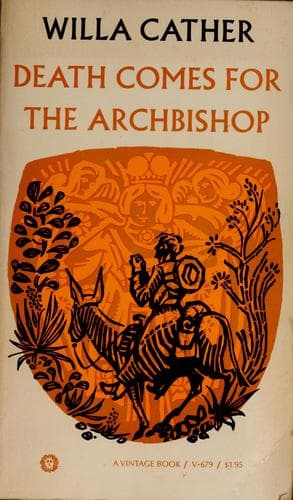
Christian fiction; Clergy -- Fiction; Historical fiction; New Mexico -- Fiction
Beside the river was a grove of tall, naked cottonwoods--trees of great
antiquity and enormous size--so large that they seemed to belong to a
bygone age. They grew far apart, and their strange twisted shapes must
have come about from the ceaseless winds that bent them to the east and
scoured them with sand, and from the fact that they lived with very
little water,--the river was nearly dry here for most of the year. The
trees rose out of the ground at a slant, and forty or fifty feet above
the earth all these white, dry trunks changed their direction, grew back
over their base line. Some split into great forks which arched down
almost to the ground; some did not fork at all, but the main trunk
dipped downward in a strong curve, as if drawn by a bowstring; and some
terminated in a thick coruscation of growth, like a crooked palm tree.
They were all living trees, yet they seemed to be of old, dead, dry
wood, and had very scant foliage. High up in the forks, or at the end of
a preposterous length of twisted bough, would burst a faint bouquet of
delicate green leaves--out of all keeping with the great lengths of
seasoned white trunk and branches. The grove looked like a winter wood
of giant trees, with clusters of mistletoe growing among the bare
boughs.
Navajo hospitality is not intrusive. Eusabio made the Bishop understand
that he was glad to have him there, and let him alone. Father Latour
lived for three days in an almost perpetual sand-storm--cut off from
even this remote little Indian camp by moving walls and tapestries of
sand. He either sat in his house and listened to the wind, or walked
abroad under those aged, wind-distorted trees, muffled in an Indian
blanket, which he kept drawn up over his mouth and nose. Since his
arrival he had undertaken to decide whether he would be justified in
recalling Father Vaillant from Tucson. The Vicar's occasional letters,
brought by travellers, showed that he was highly content where he was,
restoring the old mission church of St. Xavier del Bac, which he
declared to be the most beautiful church on the continent, though it had
been neglected for more than two hundred years.
Since Father Vaillant went away the Bishop's burdens had grown heavier
and heavier. The new priests from Auvergne were all good men, faithful
and untiring in carrying out his wishes; but they were still strangers
to the country, timid about making decisions, and referred every
difficulty to their Bishop. Father Latour needed his Vicar, who had so
much tact with the natives, so much sympathy with all their
short-comings. When they were together, he was always curbing Father
Vaillant's hopeful rashness--but left alone, he greatly missed that very
quality. And he missed Father Vaillant's companionship--why not admit
it?
Public-domain text, read in full here on John Shaqi.
Reviews
Reviews
No reviews yet
Be the first to share your thoughts on this work.
Elsewhere in the archive
Join the Discussion
Join the discussion
Sign in to leave a comment or review.
Sign InorCreate an account